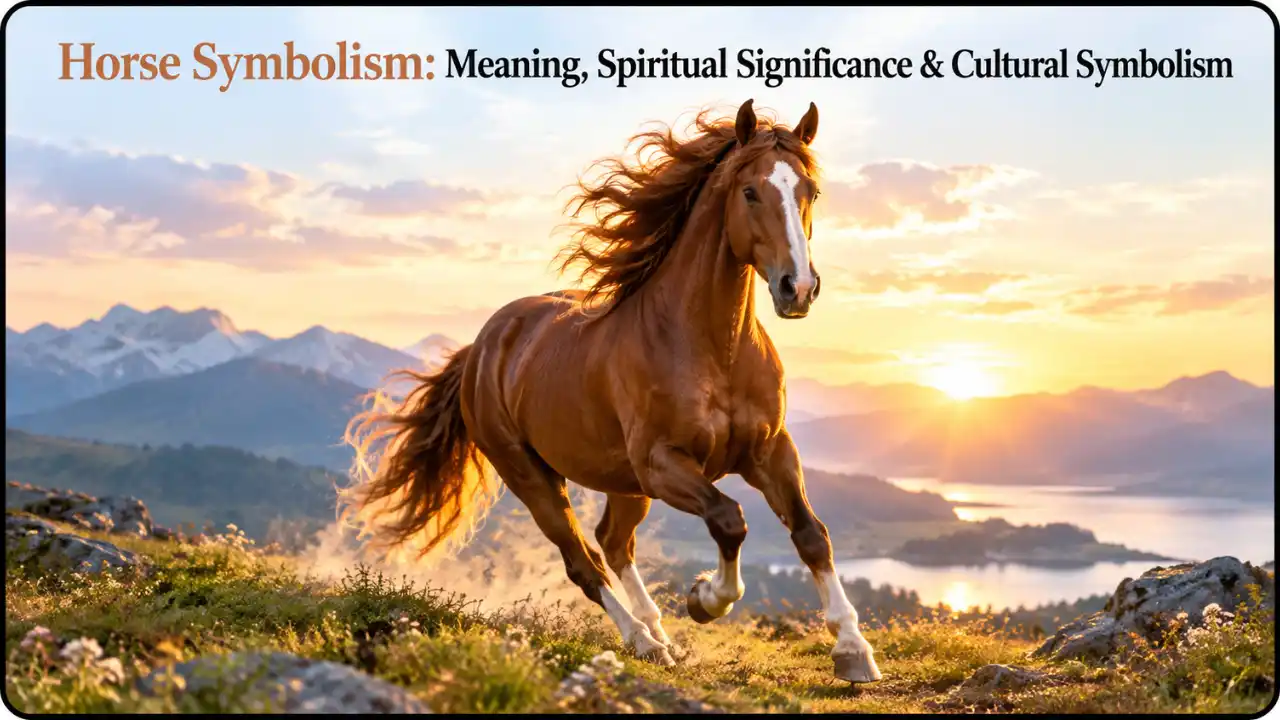
Horse symbolism is often associated with freedom, strength, courage, and personal power. Across cultures, horses can represent spiritual guidance, independence, endurance, and transformation, making them powerful symbols of movement and inner strength.
Quick Answer
Horse symbolism commonly represents freedom, strength, courage, movement, endurance, independence, and vitality. Horses have been important in mythology, religion, warfare, transportation, agriculture, and art for thousands of years. Because of this, their symbolic meanings vary widely across cultures.
TL;DR
- Horse: freedom, strength, movement, endurance, and independence
- Horse spirit animal: courage, intuition, confidence, and personal freedom
- White horse: purity, victory, peace, spirituality, or transformation
- Black horse: mystery, power, independence, and sometimes hardship
- Brown horse: stability, reliability, nature, and grounded strength
- Wild horse: freedom, independence, instinct, and untamed energy
- Horse in dreams: movement, ambition, freedom, emotional energy, or change
- Horse tattoo: freedom, strength, loyalty, courage, or personal transformation
- Galloping horse: momentum, progress, determination, and freedom
- Horse and rider: partnership, trust, control, and cooperation
You Might Also Like: Symbolism Names
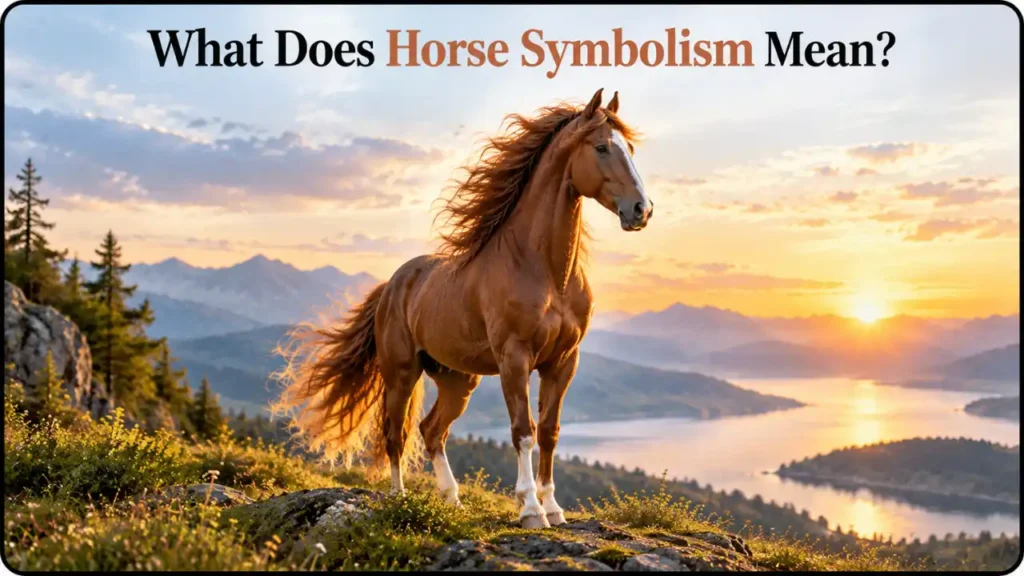
What Does Horse Symbolism Mean?
The horse is one of the most powerful animal symbols in human culture.
Its ability to run, carry people, travel long distances, and work alongside humans helped shape its symbolic importance.
Common horse meanings include:
- Freedom
- Strength
- Courage
- Speed
- Endurance
- Independence
- Loyalty
- Movement
- Adventure
- Confidence
- Vitality
- Transformation
The horse can represent both physical power and emotional freedom.
Its symbolism often centers on movement.
A horse suggests that life is not meant to remain completely still.
Horse Symbolism in Real Horse Behavior
Many symbolic meanings are connected to observable qualities of horses.
Horses are powerful, social animals capable of running quickly and covering significant distances.
Their movement naturally contributes to associations with freedom, speed, and energy.
Their long history of working alongside humans also contributes to symbolic ideas of:
- Partnership
- Trust
- Cooperation
- Service
- Loyalty
These real-world qualities help explain why horses appear so frequently in mythology and art.
Spiritual Meaning of the Horse
Spiritually, horses are often associated with freedom, personal power, movement, and life energy.
A horse may symbolize the ability to move through difficult circumstances while maintaining independence.
Common spiritual interpretations include:
- Trusting your instincts
- Moving forward
- Finding personal freedom
- Developing confidence
- Releasing limitations
- Embracing change
- Following your own direction
Horse symbolism can therefore represent a journey.
The destination matters, but the movement itself can also carry meaning.
Horse Spirit Animal Meaning
In modern spiritual symbolism, a horse spirit animal is often associated with freedom, courage, independence, and personal strength.
It may represent someone who values autonomy.
It can also symbolize a desire to break away from limitations.
The horse’s message is often interpreted as:
Move forward with confidence while remaining connected to your instincts.
Spirit-animal traditions differ across cultures, so this modern interpretation should not be presented as one universal belief.
Horse Symbolism in Native American Traditions
Horse symbolism among Indigenous peoples of North America is diverse and historically specific.
Horses became especially important to many Plains cultures after their introduction to North America by Europeans.
Horses transformed transportation, hunting, warfare, trade, and travel for many communities.
Because of this history, horses can carry meanings connected with:
- Mobility
- Strength
- Freedom
- Partnership
- Status
- Survival
- Travel
However, there is no single “Native American horse meaning.”
Different nations have distinct traditions and relationships with horses.
Horse Symbolism in Celtic Tradition
Horses held important roles in Celtic mythology and culture.
One famous figure is Epona, a goddess associated with horses.
She was particularly important among the Gauls and later within the Roman world.
Horse symbolism in Celtic contexts can therefore connect with:
- Fertility
- Travel
- Protection
- Sovereignty
- Nature
- Power
The horse could also represent movement between different realms in mythological stories.
Horse Symbolism in Greek Mythology
Horses have major roles in Greek mythology.
The god Poseidon was associated with horses as well as the sea and earthquakes.
The mythical Pegasus is perhaps the best-known Greek horse.
Pegasus is commonly associated with:
- Flight
- Inspiration
- Freedom
- Imagination
- Divine power
Greek mythology also includes the centaurs, creatures with human and horse forms.
These stories create additional symbolism around the relationship between human intelligence and animal instinct.
Horse Symbolism in Norse Mythology
Horses also have important roles in Norse mythology.
Sleipnir, Odin’s eight-legged horse, is one of the most famous.
Sleipnir is associated with extraordinary speed and movement between worlds.
This gives the horse additional symbolic connections with:
- Travel
- Power
- Speed
- Exploration
- Spiritual journeys
Norse mythology therefore presents the horse as much more than an ordinary working animal.
Horse Symbolism in Christianity
Horses appear in several important biblical passages.
The most famous example is the Four Horsemen of the Apocalypse in Revelation.
The horses in this passage are associated with different apocalyptic forces.
Because of this imagery, horse symbolism in Christian contexts can include:
- War
- Judgment
- Conquest
- Conflict
- Power
But Christian horse symbolism is not exclusively negative.
The white horse also appears in biblical imagery associated with victory and righteousness.
The meaning depends on the specific passage.
White Horse Symbolism
The white horse is one of the strongest symbolic horse images.
It can represent:
- Purity
- Victory
- Peace
- Spirituality
- Nobility
- Transformation
- Hope
However, white horse symbolism differs between cultures and religious traditions.
In some contexts, the white horse represents triumph.
In others, it can carry more specific religious or mythological meanings.
Black Horse Symbolism
Black horses often represent a more mysterious form of power.
Common symbolic interpretations include:
- Mystery
- Strength
- Independence
- Hidden energy
- Transformation
- The unknown
In some religious or mythological contexts, black horses have darker associations.
Therefore, the meaning should always be connected to the story or tradition involved.
Brown Horse Symbolism
Brown horses are often associated with grounded and practical qualities.
Symbolic interpretations can include:
- Stability
- Reliability
- Nature
- Patience
- Strength
- Security
- Dependability
Because brown is associated with earth and natural environments, the brown horse can symbolize a connection to the physical world.
Wild Horse Symbolism
The wild horse is one of the clearest symbols of freedom.
It can represent:
- Independence
- Untamed energy
- Adventure
- Instinct
- Personal freedom
- Resistance to control
A wild horse can symbolize the desire to live according to your own values.
It can also represent the need to balance freedom with responsibility.
You Might Also Like: Symbolism Names
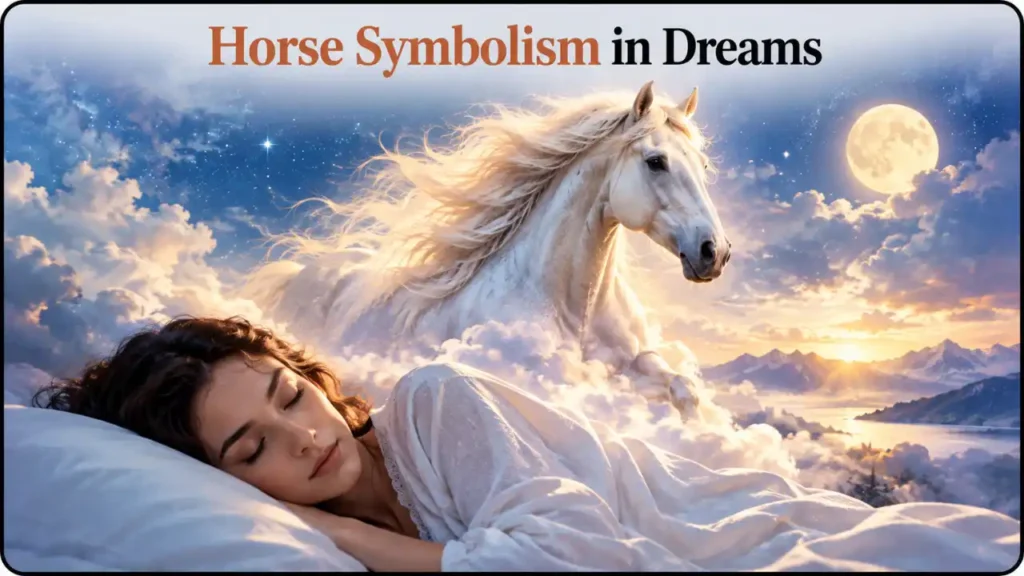
Horse Symbolism in Dreams
A horse appearing in a dream can have many interpretations.
Dream symbolism is personal.
Your feelings and the horse’s behavior can completely change the interpretation.
Riding a Horse
Riding may symbolize:
- Control
- Confidence
- Direction
- Partnership
- Progress
Running Horse
A running horse may represent:
- Freedom
- Momentum
- Energy
- Ambition
- Change
Calm Horse
A calm horse may symbolize:
- Peace
- Stability
- Trust
- Emotional balance
Frightened Horse
A frightened horse may reflect:
- Anxiety
- Loss of control
- Uncertainty
- Emotional tension
Wild Horse
A wild horse may symbolize a desire for freedom or greater independence.
Horse Symbolism in Love
Horses can represent powerful relationships built on trust and partnership.
Common romantic symbolism includes:
- Loyalty
- Freedom
- Trust
- Partnership
- Passion
- Adventure
- Mutual respect
A horse and rider can be especially meaningful.
The image suggests that successful partnership requires communication, balance, and trust.
Horse Symbolism for Strength
Few animals represent physical strength as clearly as the horse.
Horse symbolism can therefore represent:
- Endurance
- Resilience
- Courage
- Physical power
- Determination
- Persistence
But horse strength is not only about force.
A horse can symbolize controlled power.
That makes it useful as an image of strength combined with discipline.
Horse Symbolism for Freedom
Freedom is probably one of the horse’s strongest modern symbolic meanings.
The image of a horse running across an open landscape naturally suggests independence.
Horse symbolism can therefore represent:
- Breaking limitations
- Exploring new places
- Choosing your own direction
- Independence
- Adventure
- Personal growth
The wild horse makes this symbolism particularly strong.
Horse and Rider Symbolism
A horse and rider can symbolize a relationship between power and direction.
The horse provides energy and movement.
The rider provides guidance.
Together, they can represent:
- Trust
- Partnership
- Leadership
- Cooperation
- Control
- Balance
This makes horse-and-rider imagery particularly meaningful in art and tattoos.
Horse Tattoo Symbolism
Horse tattoos can represent many personal ideas.
Common meanings include:
- Freedom
- Strength
- Courage
- Loyalty
- Adventure
- Independence
- Family
- Transformation
- Connection with nature
A running horse tattoo can emphasize freedom.
A white horse tattoo can suggest purity or victory.
A wild horse tattoo can represent independence.
A horse and rider tattoo can symbolize partnership and trust.
Horse Symbolism in Different Colors
| Horse Color | Common Symbolic Associations |
|---|---|
| White | Purity, victory, peace, spirituality |
| Black | Mystery, power, independence |
| Brown | Stability, nature, reliability |
| Gray | Wisdom, maturity, transition |
| Chestnut | Energy, warmth, vitality |
| Golden | Success, prosperity, confidence |
These are broad symbolic interpretations.
They are not universal cultural meanings.
Positive and Negative Horse Symbolism
Horse symbolism can have both positive and shadow meanings.
| Positive Meaning | Shadow Meaning |
|---|---|
| Freedom | Restlessness |
| Strength | Stubbornness |
| Speed | Impulsiveness |
| Independence | Isolation |
| Courage | Recklessness |
| Energy | Lack of control |
| Loyalty | Dependence |
| Adventure | Risk-taking |
This duality makes horse symbolism more realistic.
Freedom can be empowering.
But freedom without direction can also become chaotic.
What Does It Mean When You See a Horse?
Seeing a horse is not automatically a supernatural sign.
It may simply be an ordinary encounter.
If you personally interpret animal encounters symbolically, however, you can reflect on what the horse represents to you.
Possible themes include:
- Freedom
- Movement
- Courage
- Independence
- New opportunities
- Personal strength
- A need for change
The meaning is personal rather than scientifically established.
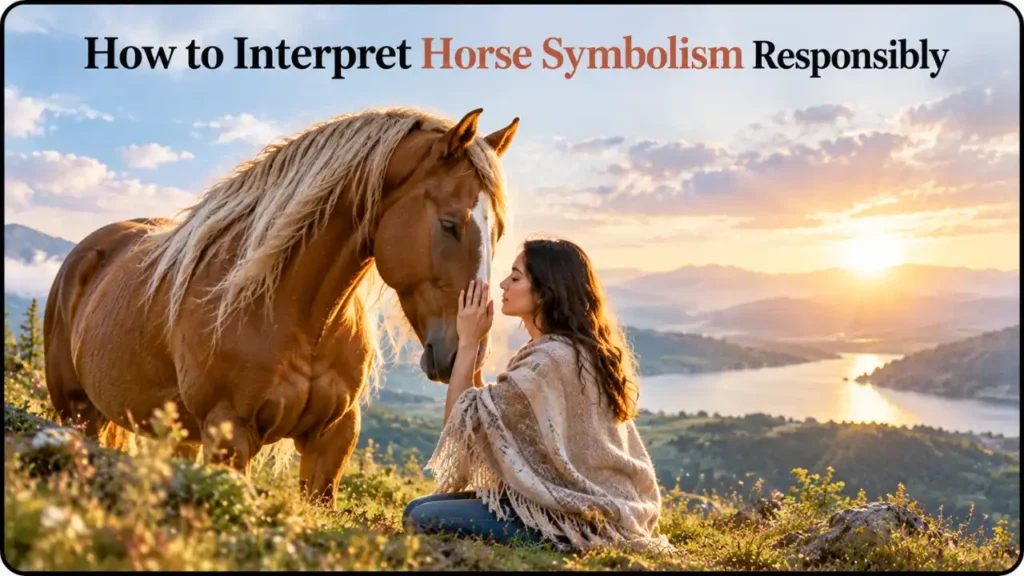
How to Interpret Horse Symbolism Responsibly
Horse symbolism becomes more meaningful when you consider its context.
Ask yourself:
- What type of horse is it?
- What is the horse doing?
- What emotions does the image create?
- Which culture or tradition is involved?
- Is the symbolism historical, religious, or modern?
These questions help prevent different traditions from being incorrectly combined.
You Might Also Like: Symbolism Names
Frequently Asked Questions
What does a horse symbolize?
A horse commonly symbolizes freedom, strength, courage, movement, endurance, independence, and vitality.
What does a horse symbolize spiritually?
Spiritually, horses are often interpreted as symbols of freedom, personal power, movement, courage, and transformation.
What does a white horse symbolize?
A white horse can symbolize purity, victory, peace, spirituality, hope, or transformation.
What does a black horse symbolize?
A black horse may represent mystery, independence, power, transformation, or the unknown.
What does a wild horse symbolize?
A wild horse strongly represents freedom, independence, instinct, adventure, and untamed energy.
What does a horse mean in a dream?
A horse in a dream may symbolize freedom, ambition, movement, confidence, emotional energy, or change.
What does a horse tattoo symbolize?
A horse tattoo can represent freedom, strength, courage, loyalty, independence, adventure, or transformation.
What does a horse symbolize in love?
Horse symbolism in love can represent trust, loyalty, freedom, partnership, passion, and mutual respect.
Conclusion
Horse symbolism is closely connected with freedom, strength, movement, and independence.
The horse can represent the desire to explore.
It can also symbolize endurance and the ability to keep moving through difficult circumstances.
Different cultures add their own meanings.
Greek mythology connects horses with figures such as Poseidon and Pegasus.
Norse mythology gives the horse a role in extraordinary journeys through Sleipnir.
Christian symbolism uses horses in both positive and challenging contexts.
Ultimately, the horse represents a powerful combination of energy, freedom, partnership, and forward movement.