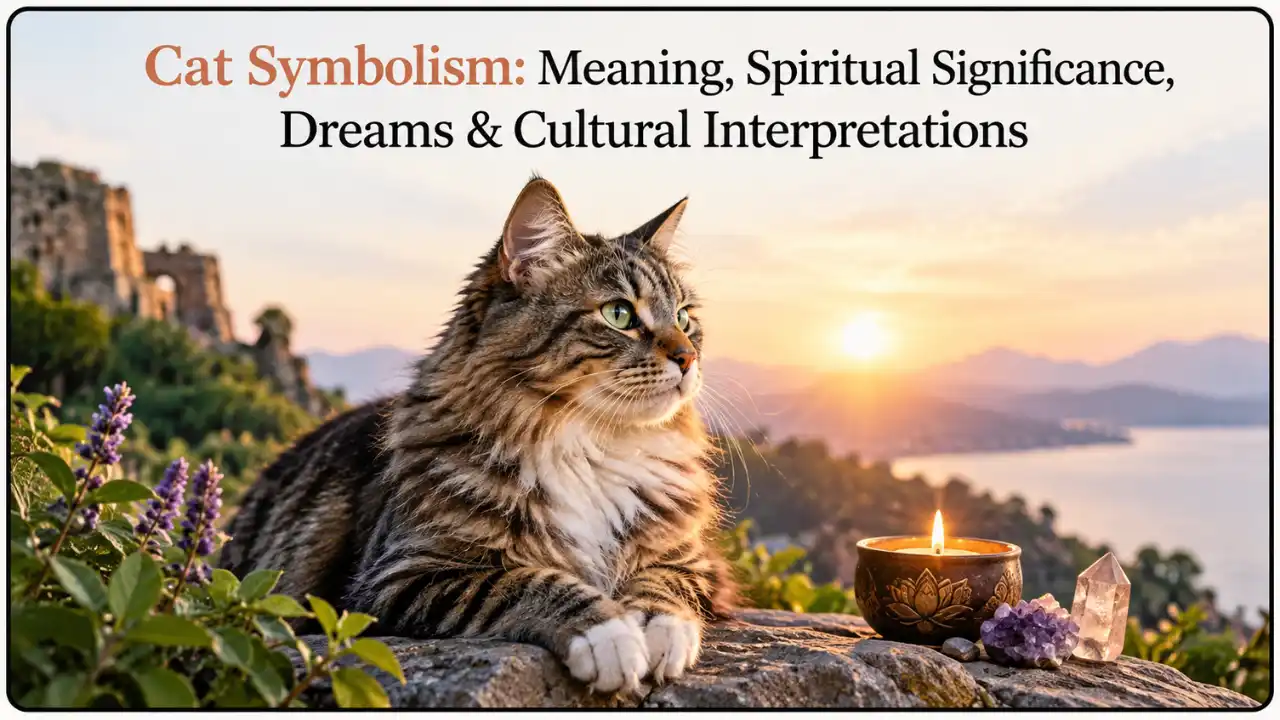
Cat symbolism is often connected to independence, intuition, mystery, and protection. Across cultures and dreams, cats can represent spiritual awareness, curiosity, freedom, and hidden emotions, with their meaning often shaped by the situation and personal beliefs.
Quick Answer
Cat symbolism often represents independence, intuition, mystery, curiosity, protection, adaptability, and quiet confidence. Cats can also symbolize patience and observation because they often remain alert before acting.
The meaning changes across cultures and situations. A cat in a dream may suggest something different from a cat used in religious art, mythology, or a tattoo.
TL;DR
- Independence: Cats are strongly associated with self-reliance.
- Intuition: Their alert behavior connects them with awareness and instinct.
- Mystery: Cats often symbolize the unknown, hidden knowledge, or secrecy.
- Protection: Some traditions connect cats with household protection.
- Adaptability: Cats can represent flexibility and survival.
- Patience: Their watchful behavior can symbolize waiting for the right moment.
- Feminine symbolism: Some cultures associate cats with feminine power and protective deities.
- Dream symbolism: A cat may represent independence, intuition, relationships, or something hidden.
- Black cats: Their meaning varies greatly by culture and context.
- White cats: They may symbolize purity, peace, or spiritual themes in some modern interpretations.
You Might Also Like: Symbolism Names
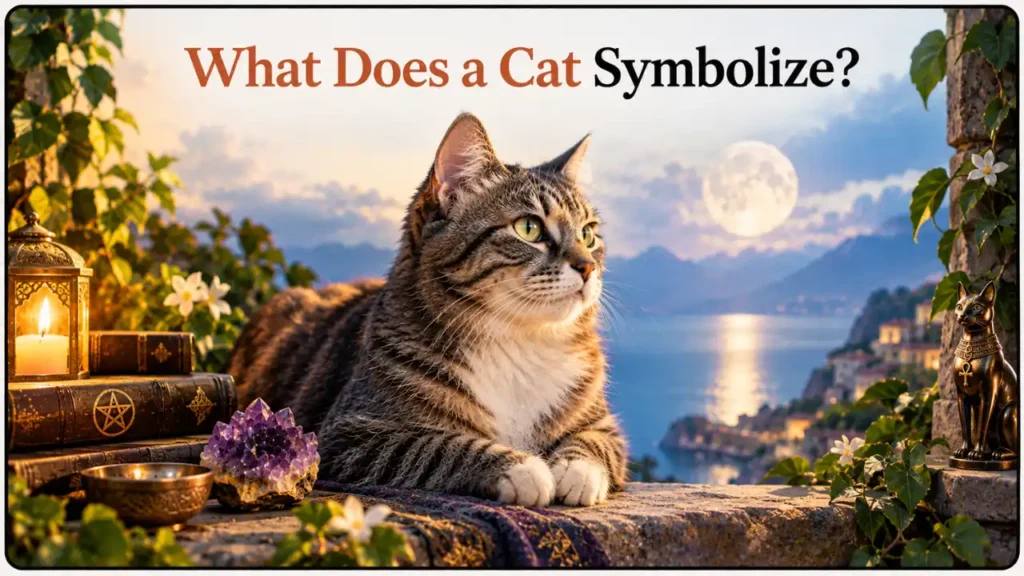
What Does a Cat Symbolize?
A cat commonly symbolizes independence, intuition, mystery, and adaptability.
Unlike symbols that communicate one fixed idea, cats have many interpretations. Their behavior helps explain why.
A cat can observe quietly without immediately reacting. This makes it a natural symbol of patience and awareness.
Cats also move independently. They can appear affectionate while still maintaining their own boundaries.
Because of these qualities, cat symbolism often centers on knowing when to act and when to remain still.
Common cat symbolism includes:
| Symbol | Meaning |
|---|---|
| Independence | Self-reliance and personal freedom |
| Intuition | Trusting instinct and awareness |
| Mystery | Secrets and the unknown |
| Curiosity | Exploration and discovery |
| Protection | Guarding people, homes, or sacred spaces |
| Patience | Waiting for the right opportunity |
| Adaptability | Adjusting to changing circumstances |
| Confidence | Quiet strength and self-assurance |
| Sensitivity | Awareness of surroundings |
| Transformation | Change and personal growth |
Cat Symbolism and Independence
Independence is one of the strongest modern associations with cats.
Cats often maintain personal boundaries. They may seek attention when they want it and retreat when they need space.
This behavior has made the cat a popular symbol of:
- Personal freedom
- Self-reliance
- Boundaries
- Individuality
- Confidence
- Autonomy
Cat symbolism can therefore encourage a person to become comfortable with their own identity.
It does not necessarily mean isolation.
Instead, it can represent being capable of standing independently while still forming meaningful relationships.
Cat Symbolism and Intuition
Cats are often connected with intuition because they appear highly alert to their surroundings.
Their movements are usually deliberate. They may stop, observe, and investigate before approaching something unfamiliar.
Symbolically, this can represent:
Observe → understand → respond.
A cat may therefore symbolize trusting your instincts while still paying attention to evidence.
This interpretation is especially common in modern spiritual symbolism.
However, intuition should be understood as a symbolic theme rather than proof that cats possess supernatural abilities.
Cats as Symbols of Mystery
Cats have long carried an association with mystery.
Their nighttime activity, quiet movements, reflective eyes, and unpredictable behavior can create a mysterious image.
As a symbol, the cat may represent:
- Hidden knowledge
- Secrets
- The unknown
- Curiosity
- Things that are not immediately understood
- The boundary between familiar and unfamiliar
This makes cats especially common in stories involving magic, folklore, fantasy, and supernatural themes.
Cat Symbolism and Protection
Cats can also symbolize protection.
This association is particularly important in traditions where cats were valued as household animals or connected with protective divine figures.
In symbolic terms, a protective cat can represent guarding the home, watching for danger, and protecting personal space.
The protection does not always need to be physical.
It can also symbolize protecting:
- Your boundaries
- Your privacy
- Your family
- Your emotional space
- Your personal values
Cat Symbolism in Ancient Egypt
Ancient Egyptian culture is one of the most famous historical contexts for cat symbolism.
Cats were associated with the goddess Bastet, whose imagery developed over time and became strongly connected with protection, domestic life, fertility, and motherhood.
Cats also had practical importance because they could help control pests.
Their cultural importance went beyond their usefulness, however.
Egyptian cat imagery became associated with protection and the sacred status of certain animals.
It is important not to reduce Egyptian cat symbolism to simply “cats were worshiped.” Ancient Egyptian religious beliefs were more complex than that.
Cat Symbolism in Other Cultures
Cat symbolism changes significantly across cultures.
There is no single universal interpretation.
Japan
Japanese culture has several important cat-related symbols.
The maneki-neko, or beckoning cat, is widely recognized as a symbol associated with good fortune, welcome, and prosperity.
Its raised paw has helped make the figure an enduring cultural symbol.
Europe
European folklore contains both positive and negative cat associations.
Cats could be viewed as household companions and useful animals.
At other times, folklore connected cats with witches, magic, or supernatural beliefs.
These interpretations varied by period and region.
Islamic Cultural Contexts
Cats have a long history of being valued as domestic animals in many Muslim societies.
However, modern claims about a single universal “Islamic meaning of cats” can oversimplify diverse traditions and historical contexts.
Celtic and Other European Folklore
Cats appear in several European legends and folklore traditions.
Their independence and mysterious behavior contributed to associations with magic and the supernatural.
These stories should be understood as folklore rather than historical evidence that cats possess supernatural powers.
Black Cat Symbolism
Black cats have some of the most complicated symbolism.
Their meaning depends heavily on cultural context.
In some modern settings, black cats symbolize:
- Mystery
- Elegance
- Independence
- Protection
- Magic
- The unknown
In other traditions, black cats became associated with bad luck or witchcraft.
These negative associations are cultural beliefs rather than evidence that black cats actually cause bad luck.
A black cat appearing in a story can therefore represent either mystery and power or fear and superstition, depending on the context.
White Cat Symbolism
White cats are often given more positive symbolic meanings in modern interpretations.
They may represent:
- Peace
- Purity
- Calm
- Innocence
- Spirituality
- Renewal
However, color symbolism is not universal.
A white cat in one cultural setting may carry a very different meaning somewhere else.
Cat Symbolism in Dreams
Dreams involving cats can be interpreted in many ways.
There is no scientifically established dictionary that assigns one universal meaning to every dream symbol.
Instead, the most useful approach is to consider the cat’s behavior and your feelings during the dream.
A friendly cat
A friendly cat may symbolize comfort, companionship, independence, or trust.
An aggressive cat
An aggressive cat might represent conflict, boundaries, fear, or a situation that feels unpredictable.
A hiding cat
A hiding cat could symbolically connect with secrecy, avoidance, uncertainty, or something you have not fully understood.
A playful cat
A playful cat may represent curiosity, creativity, freedom, or the need for more enjoyment.
A sleeping cat
A sleeping cat can symbolize rest, patience, calmness, or waiting.
The personal context matters more than a fixed dream dictionary.
You Might Also Like: Symbolism Names
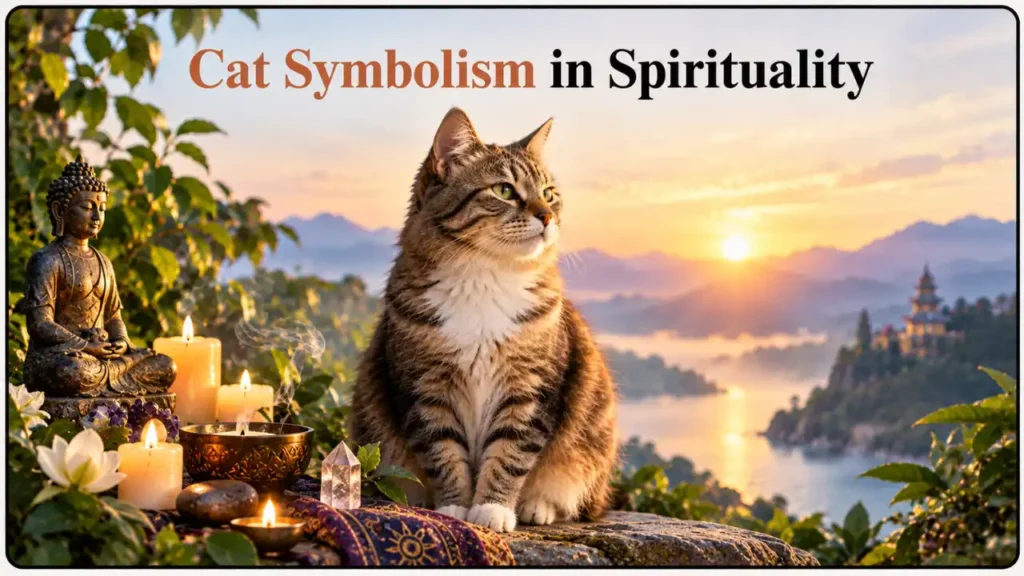
Cat Symbolism in Spirituality
In modern spiritual writing, cats are frequently associated with:
- Intuition
- Inner awareness
- Independence
- Mystery
- Protection
- Personal boundaries
- Spiritual curiosity
Some people interpret repeated encounters with cats as meaningful personal experiences.
That can be useful as a personal reflection practice, but it should not automatically be treated as evidence of a supernatural message.
A balanced interpretation asks:
What does the cat represent to me, and why does this symbol feel important right now?
Cat Symbolism in Christianity
Cats do not have one major, universal symbolic role in Christian theology comparable to symbols such as the cross, lamb, dove, or fish.
However, cats appear in later European art, folklore, literature, and cultural traditions.
Some later folklore connected cats with witchcraft and superstition.
Those associations should not be confused with a universal biblical teaching about cats.
The Bible itself does not establish a standard symbolic meaning for cats.
Cat Symbolism in Tattoos
Cat tattoos can communicate very personal meanings.
Common interpretations include:
- Independence
- Love for cats
- Curiosity
- Mystery
- Freedom
- Protection
- Personal transformation
- Remembering a beloved pet
A cat tattoo can also represent someone’s personality or life experience.
For example, a person might choose a cat because it represents being independent without losing compassion.
The surrounding design also changes the meaning.
A moon, flowers, stars, crown, or geometric pattern can introduce additional symbolism.
Cat Symbolism and Feminine Power
Cats are sometimes associated with feminine energy in modern symbolism.
This connection comes partly from historical associations between cats and female deities, especially Bastet.
Modern interpretations may connect cats with:
- Grace
- Independence
- Confidence
- Sensitivity
- Protective instincts
- Personal power
However, these meanings should not be treated as universal definitions of femininity.
A cat can symbolize these qualities for anyone.
Cat Symbolism: Positive and Negative Meanings
Cat symbolism can contain both positive and negative themes.
Positive meanings
- Independence
- Intelligence
- Curiosity
- Protection
- Adaptability
- Patience
- Awareness
- Confidence
- Mystery
- Freedom
Negative interpretations
- Secrecy
- Distrust
- Isolation
- Unpredictability
- Suspicion
- Manipulation
- Fear of the unknown
Negative symbolism usually depends on the story, culture, or situation.
A mysterious cat is not automatically a negative symbol.
Cat vs. Lion Symbolism
Cats and lions share some symbolic qualities, but their meanings often differ.
| Cat | Lion |
|---|---|
| Independence | Leadership |
| Mystery | Authority |
| Intuition | Courage |
| Curiosity | Strength |
| Adaptability | Royal power |
| Personal boundaries | Public dominance |
| Quiet confidence | Command |
A cat often represents personal power.
A lion more often represents visible authority and leadership.
What Does It Mean When a Cat Keeps Appearing?
If you repeatedly notice cats, there are several ways to approach the experience.
A symbolic interpretation might focus on:
- Independence — Are you becoming more self-reliant?
- Boundaries — Do you need more personal space?
- Intuition — Are you ignoring something your instincts are telling you?
- Curiosity — Is there something you need to explore?
- Patience — Would waiting produce a better result?
- Protection — Is there something important you want to protect?
The strongest interpretation usually comes from your own circumstances.
There is no need to assume every cat encounter carries a supernatural message.
How to Interpret Cat Symbolism Personally
When interpreting a cat symbol, consider five questions:
1. What was the cat doing?
Behavior often provides the strongest clue.
2. What color was it?
Color can influence the symbolic interpretation.
3. Where did you encounter it?
A home, dream, artwork, story, or tattoo can create different meanings.
4. How did you feel?
Fear, comfort, curiosity, happiness, or uncertainty can change the interpretation.
5. What is happening in your life?
Personal circumstances often provide the most useful context.
This approach is better than assigning one rigid meaning to every cat.
You Might Also Like: Symbolism Names
Frequently Asked Questions
What is the main symbolism of a cat?
The most common symbolic themes are independence, intuition, mystery, curiosity, adaptability, and protection.
Are cats a symbol of good luck?
In some cultures and traditions, cats or cat figures are associated with good fortune. The famous Japanese maneki-neko is one example.
What does a black cat symbolize?
A black cat can symbolize mystery, independence, magic, or the unknown. Some folklore traditions also associate black cats with bad luck, but this is superstition rather than fact.
What does a cat symbolize spiritually?
Modern spiritual interpretations often connect cats with intuition, independence, awareness, mystery, and personal boundaries.
What does a cat mean in a dream?
A cat in a dream can represent different ideas depending on its behavior and your emotions. Independence, intuition, secrecy, comfort, and uncertainty are possible themes.
What does a cat symbolize in ancient Egypt?
Cats were associated with important religious and cultural ideas in ancient Egypt, particularly through the goddess Bastet, whose symbolism included protection and domestic life.
Are cats symbols of femininity?
Cats can be associated with feminine power in some historical and modern interpretations, but this is not a universal meaning.
Final Thoughts
Cat symbolism is ultimately about independence, awareness, mystery, and personal boundaries.
Cats can represent quiet confidence rather than loud authority. Their symbolic power often comes from their ability to observe before acting.
Across cultures, cats have taken on different meanings. Some traditions emphasize protection and prosperity. Others focus on mystery, magic, or superstition.
The most accurate interpretation therefore depends on culture, historical context, personal experience, and the situation in which the cat appears.
Rather than asking, “What does every cat symbolize?” a better question is:
“What does this particular cat represent in this particular context?”
That approach produces a more thoughtful and culturally respectful interpretation.