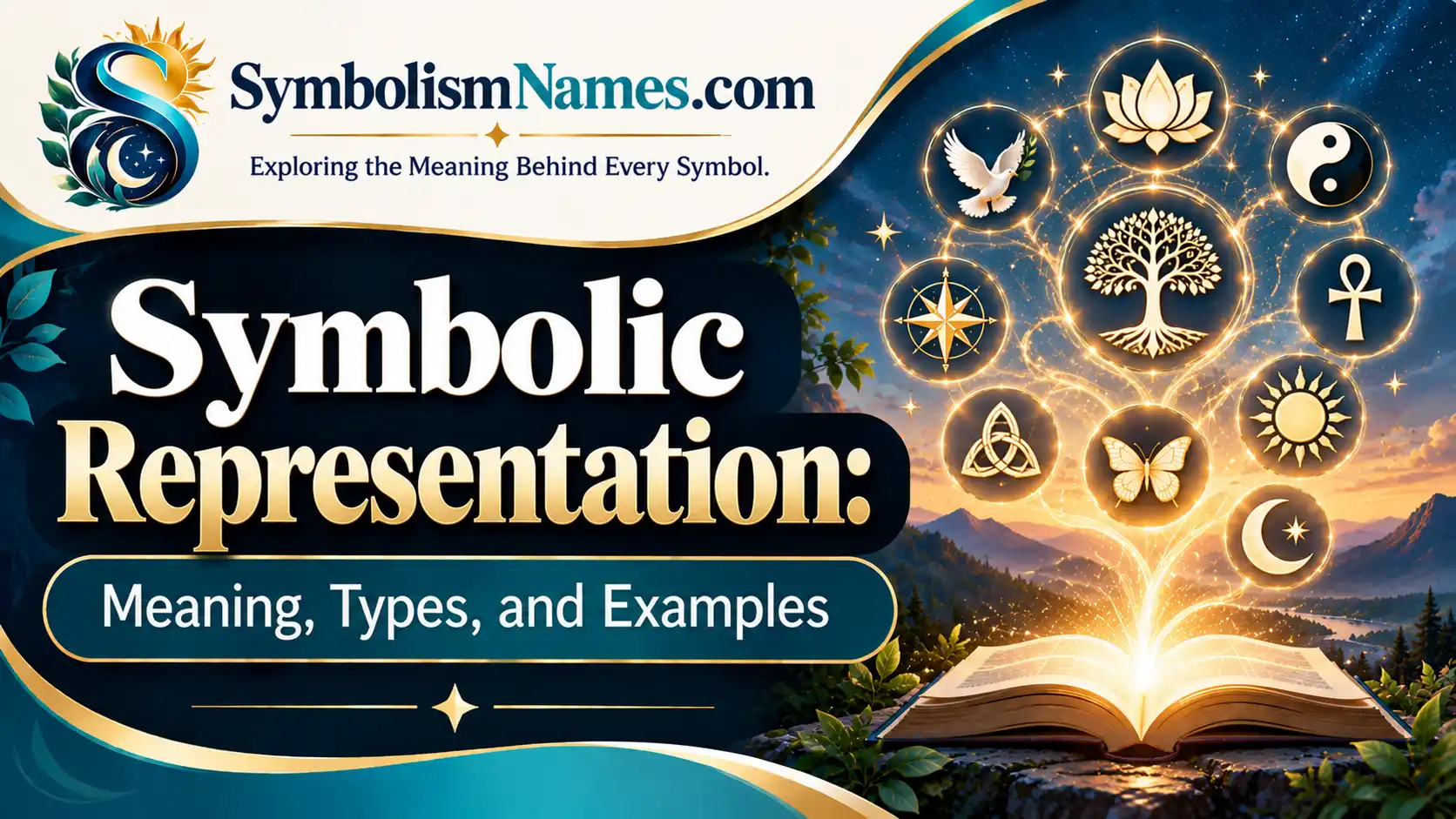
Symbolic representation helps us understand how a word, image, object, or gesture can stand for a deeper idea. It appears in language, art, psychology, mathematics, literature, culture, and everyday communication.
In this guide, you’ll learn what symbolic representation means, how it works, and how to recognize it in real examples. We’ll also explore symbols, signs, cultural context, common interpretation mistakes, and simple ways to understand symbolic meaning without assuming every symbol has one fixed definition.
Quick Answer
Symbolic representation is when a symbol stands for an object, idea, relationship, or abstract concept. Words, numbers, images, gestures, and cultural objects can all function as symbolic representations.
The exact meaning depends on the system and context. In psychology, education, semiotics, art, and literature, the term can describe related but different forms of representation. APA Dictionary
TL;DR
- Symbols can represent concrete or abstract ideas.
- Meaning often comes from learned conventions.
- Language is a major symbolic system.
- Bruner identified three representation modes.
- Culture can change symbolic meanings.
- Context helps guide interpretation.
What Does Symbolic Representation Mean?
Symbolic representation uses one form to stand for something else. That form can be a word, number, image, object, gesture, sound, or other symbol.
Consider the word “tree.” The word does not look like a tree. English speakers learn that the word represents the concept of a tree. This learned relationship is a basic example of symbolic representation. APA Dictionary
The phrase also has specialist meanings. Psychology focuses on mental representation, while semiotics examines how signs create meaning. Education often discusses symbolic representation as one way of representing knowledge.
How Does Symbolic Representation Work?
A symbol works because people connect it with something else. That connection may come from language, social convention, education, culture, or repeated use.
The relationship does not always depend on physical resemblance. A photograph resembles its subject, but a written word usually does not. Both can represent something, but they do so through different relationships. DOI
Symbolic Representation in Psychology
In psychology, symbolic representation can describe mentally representing objects and experiences through symbols. Language, sounds, and pretend play can all involve symbolic representation. APA Dictionary
This ability lets people think about things that are not directly present. A person can remember an event, imagine a future situation, or discuss an object through symbolic forms.
Bruner’s Three Modes of Representation
Jerome Bruner described three broad modes of representing knowledge: enactive, iconic, and symbolic. Enactive representation involves action, iconic representation involves images, and symbolic representation uses systems such as language. The Open University
A useful example is learning a mathematical idea. A learner might handle physical objects, view a diagram, and then work with numbers or equations. These forms can support one another.
Symbolic Representation in Language
Language is one of the clearest examples of symbolic representation. Words allow people to discuss objects, actions, feelings, and abstract ideas without having those things physically present.
Letters also function within a symbolic system. They represent sounds or language units according to learned conventions. Numbers provide another system for representing quantities and relationships.
Symbolic Representation in Mathematics
Mathematics depends heavily on symbolic representation. Numerals, operators, variables, equations, and other notation allow complex relationships to be expressed in compact forms.
For example, 5 + 3 = 8 represents a mathematical relationship. The symbols do not physically contain eight objects, but readers trained in the system understand the relationship they express.
Symbolic Representation in Art
Artists can use objects, colors, figures, settings, and compositions to communicate ideas beyond literal appearance. The meaning can depend on cultural tradition, historical period, artistic context, or the work itself. jerwoodvisualarts.org
A symbol should not automatically receive one fixed interpretation. A particular color or object may carry different meanings across cultures and artworks.
Symbolic Representation in Literature
Literary works often use objects, places, characters, or repeated images as symbols. A journey might support ideas about change, while a recurring season might support themes of growth or decline.
The surrounding story matters. Readers should examine how the symbol behaves within the text instead of relying only on a general symbol dictionary.
Symbolic Representation in Culture
Cultures develop shared meanings around objects, gestures, colors, ceremonies, stories, and images. These meanings can be taught, repeated, inherited, and changed over time.
This makes cultural context essential. A symbol that represents one idea in one community may represent another idea somewhere else. Open Indiana | Indiana University Press
Symbolic Representation in Semiotics
Semiotics is the study of signs and meaning. In a widely used framework associated with Charles Sanders Peirce, icons relate through resemblance, indexes through indication or connection, and symbols through convention. DOI
The categories are useful, but real communication can combine them. An advertisement, interface, photograph, or gesture may contain several kinds of representational relationships at once.
Symbol vs Sign vs Symbolic Representation
A sign is a broad term for something that communicates or points toward meaning. A symbol is commonly understood as a representational form whose meaning depends strongly on convention or learned association.
Symbolic representation describes the relationship between the symbol and what it represents. Therefore, the terms overlap, but they are not always interchangeable.
Symbolic Representation vs Symbolism
These terms are closely related but not identical. Symbolic representation focuses on something standing for something else, while symbolism often describes the use, system, or significance of symbols.
For example, a heart image can be a symbolic representation of affection. Repeated use of heart imagery throughout a story can form part of that story’s symbolism.
Symbolic Representation vs Metaphor and Allegory
A metaphor creates a comparison or transfer of meaning between different things. A symbol is usually an element that carries additional meaning within a particular context.
An allegory generally works on a larger scale. Characters, events, and settings may collectively represent another idea or story. These concepts can overlap, but they should not be treated as exact synonyms.
Common Examples of Symbolic Representation
Examples appear throughout everyday life:
- A flag can represent a nation or community.
- A numeral can represent a quantity.
- A word can represent an object or idea.
- A heart can represent affection in some contexts.
- A map can represent a physical location.
- A musical note can represent a sound.
- An emblem can represent an organization.
- A gesture can carry a learned social meaning.
The meaning of each example depends on the system in which people understand it.
How to Interpret Symbolic Representation
Start with the immediate context. Ask what the symbol appears beside, who created it, and who is expected to understand it.
Then consider cultural and historical context. Look for repetition, contrast, placement, and surrounding language. These clues can provide stronger evidence than assuming a symbol has one universal meaning.
Common Mistakes When Interpreting Symbols
The biggest mistake is treating symbolic meanings as universal facts. Meanings can change across cultures, periods, communities, genres, and individual works.
Another mistake is confusing resemblance with convention. A photograph resembles what it depicts, while a word usually represents its meaning through an established language system. DOI
Why Symbolic Representation Matters
Symbolic representation allows people to communicate ideas that cannot always be shown directly. It supports language, learning, mathematics, art, culture, memory, and abstract thought. Wiley Online Library
It also helps communities preserve and share knowledge. Symbols can carry information between people and generations, although their meanings can change with time.
Symbolic Representation in Modern Communication
Digital communication depends heavily on symbols. Interface icons, emojis, logos, abbreviations, notification symbols, and visual controls all use learned meanings.
A symbol that feels obvious to one audience may confuse another. Clear communication therefore depends on shared conventions, familiar design, and enough context for the intended meaning.
FAQs
What is symbolic representation in simple terms?
It is using one thing to stand for another. A word, number, image, gesture, or object can represent an idea or concept.
What is the best example of symbolic representation?
Language provides one of the clearest examples. The word “tree” represents the concept of a tree without physically resembling one.
What are Bruner’s three modes of representation?
Bruner described enactive, iconic, and symbolic representation. They involve action, images, and symbolic systems such as language. The Open University
What is symbolic representation in art?
It is using visual elements to communicate ideas beyond their literal appearance. Objects, colors, figures, and compositions can all carry symbolic meaning. jerwoodvisualarts.org
Can symbolic representation have different meanings?
Yes. Meaning can vary because symbols depend on culture, history, context, audience, and the system in which they appear.
What is the difference between an icon and a symbol?
An icon generally relates to its subject through resemblance. A symbol usually depends more strongly on learned convention. DOI
Why is symbolic representation important?
It lets people communicate abstract ideas and represent things that are not physically present. It is fundamental to many forms of language, learning, and culture.
Conclusion
Symbolic representation describes how symbols can stand for objects, ideas, relationships, and abstract concepts. It appears in language, psychology, education, mathematics, art, literature, culture, and digital communication.
The best way to understand a symbol is to examine its context first. Consider its creator, audience, cultural setting, surrounding elements, and purpose before assigning a meaning.