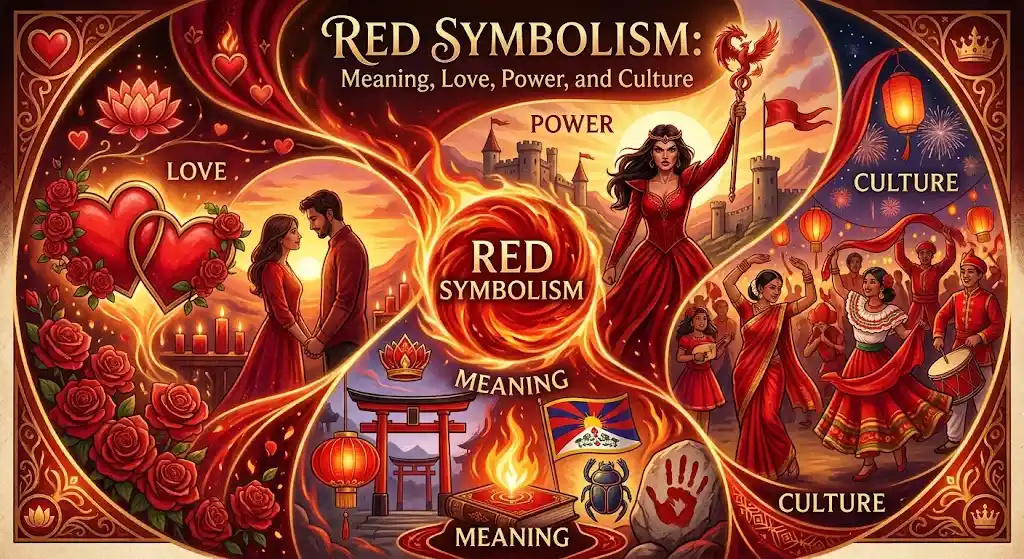
If you’re searching for red symbolism, you’re likely looking for more than a basic color definition. Red can represent love, passion, courage, danger, power, anger, sacrifice, energy, and celebration.
The meaning of red changes with the setting. A red rose, stop sign, religious garment, flag, or dream image can carry very different messages. This guide explains the major meanings of red while separating cultural traditions, spiritual interpretations, and psychological research.
Quick Answer
Red symbolism usually centers on intensity. It can represent love, passion, energy, courage, power, danger, anger, sacrifice, and urgency.
The meaning depends on the object, setting, culture, religion, and personal experience.
TL;DR
- Red often symbolizes intense emotion and energy.
- Love and passion are common modern associations.
- Red can also signal danger and urgency.
- Many cultures give red special ceremonial meanings.
- Religious meanings depend on specific traditions.
- Dreams require personal context rather than fixed rules.
- Historical use helps explain red’s powerful symbolism.
What Does Red Symbolize?
Red is often connected with powerful human experiences. Blood and fire are two major natural associations.
Blood connects red with life, sacrifice, injury, and mortality. Fire connects it with heat, energy, destruction, and transformation. These associations help explain why red can carry both positive and negative meanings.
In modern American settings, common associations include:
- Love through hearts, roses, and romantic gifts.
- Passion through strong emotional and romantic imagery.
- Energy through heat, movement, and vitality.
- Courage through heroic and ceremonial symbolism.
- Power through status, authority, and visual dominance.
- Danger through warning signs and signals.
- Anger through expressions such as “seeing red.”
- Sacrifice through blood-related religious and historical imagery.
- Celebration in several cultural traditions.
- Urgency when red is used to demand attention.
These meanings can overlap. A red flag, for example, can represent danger in one setting and political identity in another.
The Core Meanings of Red
Red’s symbolism becomes easier to understand when its major meanings are grouped by emotional direction.
Positive or energizing associations include:
- Love
- Passion
- Courage
- Confidence
- Vitality
- Celebration
- Strength
- Desire
Challenging or warning associations include:
- Anger
- Danger
- Aggression
- Conflict
- Sacrifice
- Blood
- Urgency
- Loss
This contrast isn’t a contradiction. Red often represents high emotional intensity, whether that intensity feels positive or negative.
Red Symbolism in Love and Relationships
Red is one of the strongest romantic symbols in modern American culture. Red hearts and roses appear frequently around Valentine’s Day and other romantic occasions.
A red rose can communicate love and passion without words. The same color can also suggest desire, confidence, or emotional commitment.
Research on color and emotion has found strong associations between red and love. These associations can also overlap with anger and other intense emotions.
Red therefore works well as a romantic symbol because it communicates emotional intensity, not simply affection.
Red as a Symbol of Power, Courage, and Strength
Red has long been used to create visual authority. Historical clothing, art, ceremonies, and public symbols have used strong red tones to attract attention.
Red pigments also had practical and cultural value. Historical sources on cinnabar and vermilion show that red pigments were used in art and ceremonial settings across different societies.
Today, red can still communicate confidence and boldness. Its effect often comes from contrast. A small amount of red can immediately stand out against a quieter background.
Red as a Symbol of Danger, Anger, and Warning
Red is a familiar warning color. Stop signs, brake lights, alarms, and other signals use red to communicate urgency.
Language reinforces this meaning. Expressions such as “seeing red” connect the color with anger.
Research on color and emotion also finds associations between red and anger. However, red itself doesn’t automatically make someone angry. A color association isn’t the same as a guaranteed emotional reaction.
The Spiritual Meaning of Red
Spiritual traditions often give red meanings related to life, vitality, passion, courage, grounding, protection, or sacrifice.
Some modern spiritual systems also connect red with the root chakra and themes of physical security. Those ideas belong to particular spiritual traditions and shouldn’t be presented as scientific findings.
A better approach is to identify the tradition first. Ask what red means within that belief system, rather than assuming one universal spiritual definition.
What Red Symbolizes in the Bible
Biblical red symbolism often connects with blood, sacrifice, sin, judgment, and redemption. Scarlet and crimson imagery can also appear in passages involving moral or spiritual themes.
The surrounding passage is essential. A color should not be assigned one meaning without considering the image, story, and theological context.
Christian traditions can also give red additional meaning. Red may be associated with martyrdom, sacrifice, or major religious observances.
The important distinction is between what a biblical passage actually says and later traditions that developed around particular colors.
Red Symbolism Across Different Cultures
Red is a strong example of why symbolism cannot be treated as universal.
In Chinese cultural traditions, red is widely associated with celebration, good fortune, prosperity, and important life events. Red appears prominently during Lunar New Year and weddings.
Western traditions often emphasize romance, passion, warning, and danger. Historical European uses also connect red with status, religion, war, and authority.
Color meanings can even vary within the same broad culture. A ceremonial red garment may carry a different message from an everyday red shirt.
Red Symbolism in Dreams
Dream symbolism is personal and interpretive. Red may be associated with passion, anger, urgency, conflict, energy, or transformation.
The object matters greatly. A red flower may create a romantic interpretation, while a red warning light may suggest caution.
Your emotional response matters too. Feeling happy around red creates a different interpretation from feeling frightened by it.
Use these questions when reflecting on a dream:
- What object or person was red?
- What happened immediately before the color appeared?
- What emotion did you experience?
- Did the red feel attractive or threatening?
- Does your culture give that object a special meaning?
- Does red have a personal meaning in your life?
Dream symbolism should be treated as reflection, not prediction.
Red Symbolism in Literature and Art
Artists and writers often use red to make something visually or emotionally prominent.
Red can represent:
- Love
- Desire
- Blood
- Violence
- Danger
- Guilt
- Power
- Rebellion
- Transformation
- Emotional conflict
The meaning comes from the whole work. In literature, repeated red imagery may connect with a character, conflict, or central theme.
In art, red can guide attention toward a particular figure or object. Artists may also use red against neutral colors to create contrast and emotional tension.
This is why the same red color can mean something completely different in two paintings or stories.
What Different Shades of Red Can Suggest
Not every red looks or feels the same. Shade can influence the emotional impression.
| Shade | Common Associations |
|---|---|
| Bright red | Energy, urgency, excitement |
| Crimson | Passion, depth, drama |
| Scarlet | Intensity, courage, warning |
| Burgundy | Richness, seriousness, maturity |
| Vermilion | Ceremony, history, artistic tradition |
| Dark red | Strength, depth, seriousness |
These are associations, not fixed rules. A crimson dress and crimson religious artwork can communicate very different ideas.
Historical pigment use also matters. Cinnabar and vermilion had important artistic and ceremonial histories across different societies.
Red Flowers and Natural Symbolism
A red flower combines the meaning of its color with the symbolism of the flower itself.
Red roses are the clearest example. In American culture, they strongly suggest romantic love and passion. Red can also add associations with strength, pride, and intense emotion to flower symbolism.
Nature provides other red images too. Red berries, sunsets, fire, ripe fruit, and autumn leaves can create associations with vitality, warmth, change, or abundance.
The object always matters. Red alone doesn’t determine the complete symbolic message.
The Psychology Behind Red Associations
Research provides useful insight into why people repeatedly connect colors with emotions.
International research involving more than 15,000 participants across 80 countries and 46 languages found consistent links between colors and emotions. It also found culture-specific differences.
Red is commonly associated with emotions including love and anger. These patterns help explain why red appears so often in romantic, warning, and emotionally intense imagery.
But symbolism and psychology aren’t identical. A psychological association doesn’t prove that red has one fixed meaning for every person.
How to Interpret Red in Context
Use a context-first approach when you encounter red symbolism.
- Identify the object. Red on a rose differs from red on a warning sign.
- Study the setting. A wedding, church, painting, dream, and street use different symbolic systems.
- Check the culture. Traditions can dramatically change red’s meaning.
- Notice the emotion. Ask whether red feels comforting, exciting, threatening, or powerful.
- Look at surrounding colors. Color combinations can change the visual message.
- Consider repetition. A repeated red image may carry greater thematic importance.
- Check historical context. Older works may use color differently from modern culture.
- Separate belief from evidence. Spiritual interpretations aren’t the same as psychological findings.
- Avoid universal claims. One meaning rarely explains every appearance of red.
- Read the whole situation. The strongest interpretation should fit the complete context.
Common Mistakes When Interpreting Red Symbolism
Red is easy to interpret too quickly because its common meanings are familiar.
The biggest mistake is choosing one meaning before examining the setting.
Avoid these errors:
- Assuming red always means love.
- Assuming red always represents danger.
- Treating one culture’s meaning as universal.
- Presenting spiritual beliefs as scientific facts.
- Treating dream interpretations as predictions.
- Ignoring the object carrying the color.
- Ignoring historical context.
- Applying modern meanings to ancient artwork.
- Assuming every red shade has a fixed meaning.
- Using symbolism without checking the surrounding imagery.
A better interpretation combines color + object + setting + culture + emotion.
Positive and Negative Meanings of Red
Red has a remarkable symbolic range because intensity can be experienced in different ways.
On the positive side, red can suggest love, passion, courage, energy, celebration, strength, and confidence.
On the challenging side, it can suggest anger, danger, conflict, aggression, sacrifice, blood, or urgency.
Neither side is automatically correct. A red rose and a red warning light demonstrate the difference clearly.
The most useful question isn’t simply, “What does red symbolize?” Ask instead:
What is red doing in this particular context?
That question produces a more accurate interpretation than any universal color chart.
FAQs
Is red always a symbol of love?
No. Red is strongly associated with love, but it can also represent danger, anger, power, sacrifice, and urgency.
The object and setting determine which meaning makes the most sense.
Why is red associated with danger?
Red is strongly established as a warning color in modern public systems. Its high visual impact and learned associations reinforce that meaning.
What does red mean spiritually?
Some spiritual traditions connect red with vitality, courage, grounding, passion, protection, or sacrifice.
These meanings depend on the specific tradition and should not be treated as universal facts.
What does red symbolize in the Bible?
Red commonly connects with blood, sacrifice, sin, judgment, and redemption in biblical interpretation.
Individual passages should always be interpreted through their full textual and religious context.
What does red symbolize in Chinese culture?
Red is widely connected with celebration, prosperity, good fortune, and major ceremonies in many Chinese traditions.
Its use during Lunar New Year and weddings is especially well known.
What does red symbolize in dreams?
Red in dreams can be interpreted through themes such as passion, anger, urgency, conflict, or transformation.
The dream’s object, setting, and emotional response are more useful than a fixed dream dictionary.
What does red symbolize in literature?
Red can represent love, blood, danger, violence, guilt, power, or transformation.
The author’s repeated imagery, characters, plot, and setting determine the specific meaning.
Conclusion
Red symbolism is best understood as a language of intensity. It can express love and passion, but also danger, anger, power, courage, sacrifice, and urgency.
Its meaning changes across cultures, religions, art, dreams, and everyday life. When you encounter red, start with the context rather than a fixed definition. Look at the object, setting, culture, emotion, and surrounding symbols together.
Next step: Explore related color and symbolism topics to see how red compares with other colors and symbolic traditions.