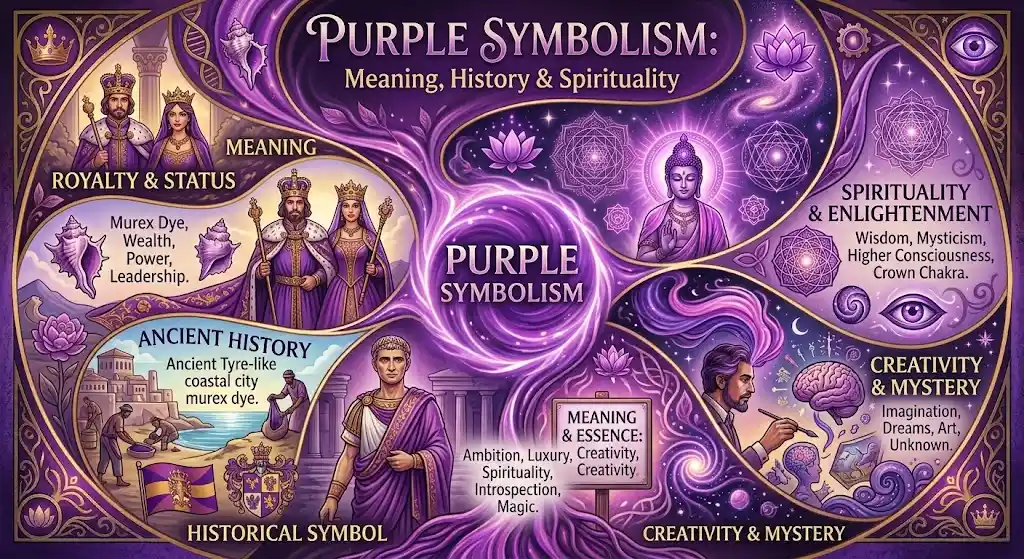
If you’re exploring purple symbolism, this guide explains what the color can represent across history, religion, culture, dreams, and daily life. Purple is commonly linked with royalty, luxury, creativity, spirituality, mystery, dignity, and individuality.
Those meanings are not universal rules. A purple robe, lavender flower, church vestment, military medal, and modern logo can communicate very different ideas. The most useful interpretation considers the shade, setting, culture, object, and historical context.
What Does Purple Symbolize?
Purple commonly symbolizes royalty, dignity, luxury, creativity, spirituality, mystery, wisdom, and individuality. Its strongest historical association comes from the rarity of costly purple dyes.
Today, purple has a wider symbolic range. It can look formal, imaginative, spiritual, dramatic, playful, or unconventional depending on how it is used.
- Royalty: linked with rulers and elite status.
- Luxury: shaped by the historical cost of purple dye.
- Dignity: often used in formal or ceremonial settings.
- Creativity: common in artistic and expressive contexts.
- Spirituality: appears in several religious and spiritual traditions.
- Mystery: its unusual visual presence can suggest the unknown.
- Wisdom: often appears in reflective or spiritual symbolism.
- Individuality: purple can feel distinctive and less conventional.
- Transformation: some symbolic systems use it for change or transition.
- Solemnity: darker purple can create a serious or reflective mood.
The key is to avoid treating every purple object as a symbol of all these ideas.
Why Is Purple Associated With Royalty?
Purple became associated with royalty because some ancient purple dyes were rare, labor-intensive, and expensive. Tyrian purple, produced from marine mollusks in the Mediterranean region, became strongly connected with wealth and high social status.
The connection was practical before it became symbolic. When only wealthy or powerful people could afford certain purple textiles, the color became a visible marker of rank. That historical memory survived after synthetic dyes made purple far easier to produce.
William Henry Perkin’s 1856 discovery of mauveine helped transform purple from an expensive luxury into a widely available fashion color.
The symbolism changed with access. Purple could still look luxurious, but it could also become fashionable, artistic, personal, and modern.
What Does Purple Mean Spiritually?
In spiritual symbolism, purple is often associated with reflection, wisdom, mystery, intuition, transformation, and a search for deeper meaning.
These are traditions and interpretations rather than scientifically proven effects. A person may connect purple with spiritual awareness because of religious practice, meditation, personal belief, or cultural tradition.
Common symbolic readings include:
- Spiritual reflection
- Wisdom and contemplation
- Mystery and the unknown
- Personal transformation
- Intuition
- Sacred authority
- Inner exploration
- Creative inspiration
- Preparation for change
- A sense of transcendence
Some modern spiritual systems connect violet or purple with the crown chakra and higher consciousness. That interpretation belongs to those particular traditions and should not be treated as a universal meaning.
Purple Meaning in Christianity and the Bible
Purple has a strong historical connection with wealth and rank in biblical settings because expensive purple textiles were associated with status. Biblical references include purple clothing, purple goods, and fine garments.
Christian traditions later gave purple additional religious meaning. In Roman Catholic practice, violet or purple is used during Advent and Lent. The U.S. Conference of Catholic Bishops describes both as seasons of preparation, with purple expressing a penitential dimension.
This creates several layers of Christian symbolism:
- Royal status
- Sacred authority
- Preparation
- Reflection
- Penitence
- Spiritual expectation
- Solemnity
- Religious ceremony
The exact meaning can vary between denominations and Christian traditions.
Purple Symbolism Across Cultures
Purple does not mean exactly the same thing in every culture. Its symbolism developed through local history, religion, politics, art, language, and social customs.
In many Western contexts, purple has a strong royal and religious history. Other societies developed different associations with purple and related shades. Research also shows that emotional associations with purple can vary between populations and languages.
When interpreting purple across cultures, ask:
- What society is being studied?
- Which historical period matters?
- Is the color used in clothing or ritual?
- Does the shade have a special name?
- Is purple connected with religion?
- Is the color associated with rank?
- Is it used during mourning?
- Does the object have its own symbolism?
- Has modern design changed the older meaning?
- Does the person have a personal association with purple?
This prevents one culture’s symbolism from being incorrectly applied to another.
Purple Meaning in Psychology
Color psychology can help explain why purple creates certain associations, but it should not be treated as a fixed personality system.
A large systematic review of color research found that color-emotion associations can be systematic while also being shaped by lightness, saturation, hue, and context. Research specifically examining purple has also found meaningful variation between populations.
Purple is often associated with:
- Power
- Distinction
- Creativity
- Imagination
- Luxury
- Mystery
- Individuality
- Reflection
The better question is not “What emotion does purple cause?” Instead, ask what association the particular purple creates in its setting.
A deep purple velvet chair may feel luxurious because the color, material, and furniture work together. A bright violet poster may feel energetic because its saturation and surrounding design change the impression.
What Different Shades of Purple Symbolize
Shade can change purple’s symbolic tone dramatically. Lightness, saturation, and surrounding colors all influence how a particular purple is perceived.
A deep purple can look formal and dramatic. Lavender can appear softer. Bright violet can feel more energetic or unconventional.
| Shade | Common Associations |
|---|---|
| Royal purple | Authority, ceremony, prestige |
| Deep purple | Luxury, mystery, seriousness |
| Violet | Imagination, spirituality, individuality |
| Lavender | Softness, delicacy, calm |
| Lilac | Gentleness, youthfulness, tenderness |
| Mauve | Subtlety, nostalgia, restraint |
| Plum | Richness, maturity, drama |
| Electric violet | Energy, originality, modernity |
These are common symbolic associations, not fixed definitions.
Purple paired with gold often reinforces a ceremonial or luxurious impression. Purple with white can appear cleaner and more restrained. Purple with black may create a darker, more dramatic effect.
What Does Purple Mean in Dreams?
Purple in a dream has no scientifically established universal meaning. Dream interpretation is personal, so the color should be considered alongside the dream’s emotions, objects, events, and personal associations.
A purple dress may suggest something different from a purple sky. A purple flower may carry a different personal meaning from a purple room.
For a thoughtful interpretation:
- Identify the exact purple shade.
- Ask what purple means to you.
- Notice the object carrying the color.
- Recall how you felt during the dream.
- Consider what happened before the color appeared.
- Look at nearby colors and objects.
- Consider your cultural or religious background.
- Think about recent experiences involving purple.
- Avoid treating dreams as predictions.
- Compare several possible interpretations before choosing one.
A dream dictionary can offer ideas, but personal context should carry more weight.
Purple Symbolism in Flowers and Nature
Purple flowers add another layer because their symbolism comes from both color and plant tradition.
Lavender, violets, iris, and other purple flowers have different histories. The color may suggest mystery or dignity, while the flower itself may carry meanings involving devotion, modesty, beauty, remembrance, or calm.
For example, lavender is often used symbolically for softness and calm, while violet has long accumulated associations with modesty and faithfulness in some traditions.
When interpreting a purple flower, consider:
- The flower species
- The shade of purple
- The culture
- The occasion
- The surrounding flowers
- The season
- The person’s relationship with the flower
- The historical tradition involved
A purple flower is therefore more than “purple symbolism.” Plant symbolism and color symbolism work together.
Purple Meaning in Love, Relationships, and Personal Expression
Purple can express individuality, admiration, elegance, affection, or mystery in personal settings.
There is no universal romantic meaning for purple. Its message depends on the relationship and the object involved.
A purple bouquet may feel thoughtful and unusual. A purple outfit may communicate personal style. A purple gift may simply reflect the recipient’s favorite color.
In relationships, purple may suggest:
- Admiration
- Individuality
- Creativity
- Elegance
- Mystery
- Affection
- Personal identity
- Emotional depth
Personal history matters. Someone who loves purple may read the color very differently from someone who connects it with a difficult memory.
Purple in Fashion, Art, and Design
Purple is especially flexible in visual design because its historical and modern associations overlap.
A dark purple suit can look formal and sophisticated. Lavender clothing can appear softer. Bright violet can make a design feel energetic and unconventional.
Designers can change purple’s impression through:
- Shade
- Brightness
- Saturation
- Material
- Typography
- Surrounding colors
- Scale
- Cultural setting
- Lighting
- Intended audience
Purple with gold can emphasize luxury. Purple with neutral colors can feel more restrained. Purple with bright complementary colors can become playful or dramatic.
The same principle applies to art. A purple landscape can make a familiar scene feel unusual, while purple clothing in a portrait can emphasize status, character, mystery, or personal identity.
Purple in American History and Public Symbols
Purple has several important meanings in U.S. history.
The National Woman’s Party used purple, white, and gold during the American women’s suffrage movement. The National Park Service records the organization’s explanation of purple as representing loyalty, constancy, and steadfast commitment to the cause.
The Purple Heart created another distinct American association. Its history reaches back to George Washington’s 1782 Badge of Military Merit. Today, the Purple Heart is awarded to service members wounded or killed while serving in the U.S. military.
These examples show why context matters.
Purple in a suffrage banner can represent political commitment. Purple on a Purple Heart represents military service and sacrifice. Neither meaning depends mainly on general color psychology.
Positive and Negative Purple Symbolism
Purple can communicate positive, neutral, or serious ideas depending on its use.
Positive associations often include:
- Royalty
- Dignity
- Creativity
- Wisdom
- Luxury
- Spirituality
- Imagination
- Individuality
More serious or negative associations can include:
- Excess
- Arrogance
- Vanity
- Distance
- Mystery
- Mourning
- Melancholy
- Overindulgence
These meanings should never be assigned automatically.
For example, a deep purple room may look luxurious to one person and overly dramatic to another. A purple religious garment may communicate solemnity rather than luxury.
How to Interpret Purple Symbolism in Context
The strongest interpretation method starts with context instead of color.
Use this sequence:
- Identify the purple object.
- Identify the exact shade.
- Check the historical period.
- Identify the cultural setting.
- Consider religious meaning when relevant.
- Look at nearby colors.
- Examine the purpose of the object.
- Consider the person’s own associations.
- Compare several possible meanings.
- Choose the interpretation best supported by the context.
This method works for art, dreams, clothing, flowers, symbols, rooms, logos, stories, and everyday objects.
It also prevents a common mistake: assuming every purple object represents royalty or spirituality.
Common Mistakes When Interpreting Purple
Color symbolism becomes unreliable when every meaning is treated as universal.
Avoid these common mistakes:
- Assuming purple always represents royalty.
- Treating spiritual meanings as scientific facts.
- Ignoring cultural differences.
- Ignoring the exact shade.
- Treating purple and violet as identical in every context.
- Assuming dreams have fixed meanings.
- Using popular psychology as a personality diagnosis.
- Ignoring the object paired with purple.
- Forgetting historical context.
- Assuming a person’s favorite color has a universal message.
- Treating symbolic interpretations as predictions.
- Copying one culture’s meaning into another culture.
Good interpretation is not about finding one “correct” answer. It is about finding the answer that best fits the evidence and context.
Purple Symbolism in Everyday Life
Purple appears in clothing, flowers, artwork, home interiors, religious settings, public symbols, celebrations, logos, and digital spaces.
Its meaning changes with the situation. A purple crown emphasizes status. A lavender flower may feel delicate. A church vestment can represent preparation. A Purple Heart represents military sacrifice. A purple design can communicate creativity or luxury.
When you encounter purple, ask three questions:
What is purple? Where is it being used? What context surrounds it?
Those questions provide a stronger interpretation than a simple list of color meanings.
FAQs
What does the color purple symbolize?
Purple commonly symbolizes royalty, luxury, dignity, creativity, spirituality, mystery, wisdom, and individuality. The exact meaning depends on context, culture, shade, and history.
Why is purple associated with royalty?
Purple became linked with royalty because some ancient purple dyes were rare and extremely expensive. That scarcity made purple clothing a visible marker of wealth and high status.
What does purple symbolize spiritually?
Purple is often associated with reflection, wisdom, mystery, transformation, and spiritual awareness. These meanings belong to particular traditions and personal interpretations rather than one universal system.
What does purple mean in dreams?
Purple in dreams can be interpreted through ideas such as creativity, spirituality, change, or personal identity. The dream’s emotional tone and your own association with purple are more useful than a fixed dream dictionary.
What does lavender symbolize?
Lavender often suggests softness, calmness, delicacy, devotion, or gentleness. Its meaning can change according to the flower’s cultural and personal context.
Is purple a positive or negative color?
Purple can represent both positive and serious ideas. It may suggest creativity and dignity, while darker or highly dramatic uses can suggest solemnity, excess, distance, or mystery.
Is purple always a symbol of royalty?
No. Royalty is one of purple’s strongest historical associations, but modern and cultural meanings also include creativity, spirituality, individuality, political history, and military remembrance.
Conclusion
Purple symbolism has developed from material history, religion, culture, art, politics, and personal expression. Its best-known meanings include royalty, luxury, dignity, creativity, spirituality, mystery, and individuality.
The most reliable way to understand purple is to look beyond the color itself. Consider its shade, object, setting, culture, history, and surrounding symbols before deciding what it represents. That approach creates a more accurate and useful interpretation.