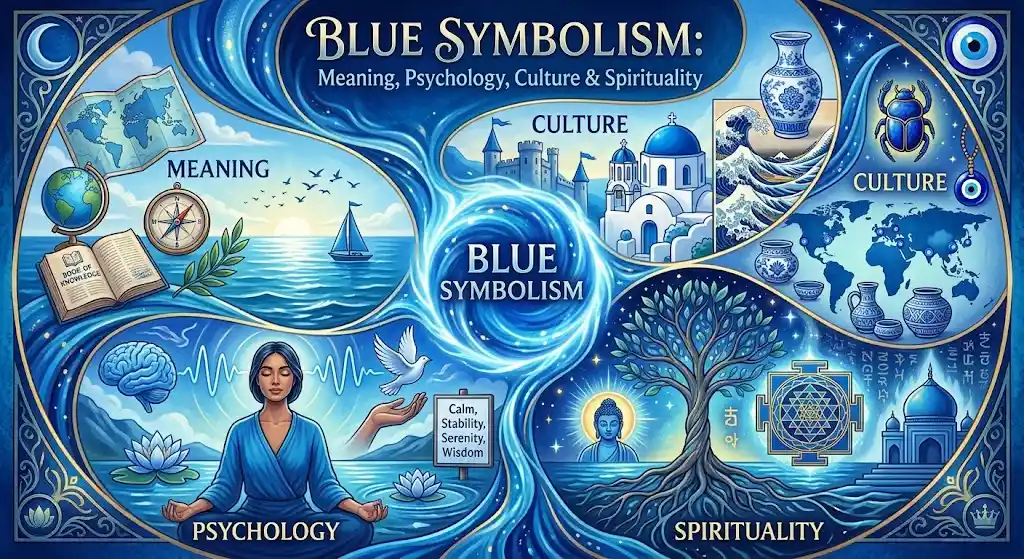
Blue Symbolism is one of the most widely recognized symbolic colors. It can represent peace, trust, loyalty, wisdom, freedom, spirituality, depth, and stability.
But blue does not have one universal meaning. Its symbolism can change based on the shade, culture, historical period, setting, surrounding colors, and personal experience.
In this guide, you’ll learn what blue symbolizes in everyday life, psychology, spirituality, religion, art, dreams, relationships, nature, branding, and design. You’ll also learn how to interpret blue without treating every symbolic association as a fixed rule.
Quick Answer
Blue symbolism commonly represents peace, trust, loyalty, stability, wisdom, freedom, spirituality, and emotional depth. In some contexts, blue can also represent sadness, distance, coldness, authority, or mystery.
The meaning depends on where and how the color appears.
TL;DR
- Blue commonly represents peace, trust, and loyalty.
- Dark blue often feels serious and authoritative.
- Light blue often suggests calmness and openness.
- Blue can represent sadness as well as peace.
- Cultural traditions can change blue’s meaning.
- Shade and context strongly affect interpretation.
What Does Blue Symbolize?
Blue commonly symbolizes calmness, trust, loyalty, stability, wisdom, freedom, and depth. These associations come from nature, language, religion, art, history, and modern design.
The sky and ocean are two major sources of blue’s symbolic power. The sky can suggest freedom and openness, while deep water can suggest mystery and emotional depth.
Blue can also have less positive meanings. In English, expressions such as “feeling blue” connect the color with sadness or melancholy.
Common symbolic meanings of blue include:
- Peace: quietness, harmony, and emotional stillness
- Trust: reliability, honesty, and dependability
- Loyalty: faithfulness and commitment
- Wisdom: knowledge, reflection, and maturity
- Stability: consistency, order, and security
- Freedom: open skies, space, and possibility
- Spirituality: contemplation, heaven, and transcendence
- Depth: emotional, intellectual, or physical depth
- Sadness: melancholy, longing, or loneliness
- Authority: seriousness, discipline, and professionalism
- Distance: separation or emotional reserve
- Mystery: the unknown and hidden depth
These meanings are best understood as associations rather than universal rules.
The Core Meanings of Blue Symbolism
Blue has a broad symbolic range because people experience it through many parts of life. A blue sky, ocean, uniform, painting, or room can create completely different impressions.
That is why context matters more than memorizing a single definition.
The most common meanings include:
- Peace: Blue can suggest quietness and emotional balance.
- Trust: It often communicates reliability and dependability.
- Loyalty: “True blue” is associated with faithfulness.
- Wisdom: Deep blue can suggest thoughtfulness and reflection.
- Freedom: The open sky gives blue a natural connection with freedom.
- Spirituality: Blue can suggest heaven, contemplation, or sacred space.
- Depth: Oceans and dark shades create associations with hidden depth.
- Stability: Blue can appear dependable and consistent.
- Authority: Navy blue often feels formal and serious.
- Sadness: Cultural expressions connect blue with melancholy.
- Distance: Blue can suggest emotional or physical separation.
- Mystery: Dark blue can create a sense of the unknown.
The surrounding situation determines which meaning becomes strongest.
Why Can Blue Represent Both Peace and Sadness?
Blue can seem contradictory because it represents both peace and sadness. This happens because symbolic meanings develop through different cultural and visual experiences.
A clear blue sky can suggest freedom, hope, and peace. A dark blue scene in a film can instead suggest loneliness, grief, or emotional distance.
The surrounding imagery often decides the emotional message.
For example:
- Calm blue water can suggest peace.
- Rough blue water can suggest uncertainty.
- A bright blue sky can suggest hope.
- A dark blue room can feel quiet or isolated.
- Blue clothing can suggest loyalty or emotional reserve.
- Blue lighting can create a cold or lonely atmosphere.
The phrase “feeling blue” is another example of cultural language connecting blue with sadness.
This does not mean blue naturally causes sadness. Rather, repeated cultural use has created a familiar symbolic association.
Blue Symbolism in Psychology
Blue is frequently discussed in color psychology because people often associate it with calmness, stability, trust, and professionalism.
However, color psychology should not be confused with symbolic interpretation. A symbolic association describes how a color is commonly understood. It does not prove that every person will experience the same emotional response.
Shade also makes a difference.
A soft blue may feel gentle and open. A dark navy may feel formal, serious, or authoritative. A highly saturated blue can feel energetic and bold.
When interpreting blue psychologically, consider:
- Shade
- Brightness
- Saturation
- Lighting
- Surrounding colors
- Location
- Cultural background
- Personal experience
- Intended message
- Emotional atmosphere
Blue can support a visual message of trust, but color alone cannot create genuine trust.
A company can use blue in its branding, for example, but its actual behavior determines whether customers trust it.
Spiritual Meaning of Blue
Blue often carries spiritual associations with peace, truth, wisdom, heaven, protection, contemplation, and transcendence.
These associations differ between spiritual and religious traditions. Some people connect blue with the sky and therefore with heaven. Others connect it with water, reflection, purity, or inner calm.
Common spiritual interpretations include:
- Peace: a quiet and reflective state
- Truth: honesty and sincere expression
- Wisdom: thoughtful understanding
- Protection: symbolic protection in certain traditions
- Heaven: connection with the blue sky
- Contemplation: stillness and inward reflection
- Spiritual depth: ideas beyond ordinary experience
- Communication: truthful expression or prayer
These meanings should not be treated as universal spiritual facts.
A blue object may carry one meaning in a specific tradition and a completely different meaning in another.
Blue Symbolism in the Bible and Religion
Blue has a significant place in several religious traditions, but its meaning must be understood within its historical context.
In ancient Israelite tradition, blue appears in descriptions of sacred clothing and ritual objects. The biblical use of blue therefore connects the color with religious practice and remembrance.
Christian art later developed strong associations between blue and heavenly themes. Blue also became closely connected with artistic representations of the Virgin Mary in European Christian art.
The Metropolitan Museum of Art discusses blue as a color associated with Heaven in Christian art.
Jewish tradition provides another important example through tekhelet, a blue dye associated with ritual fringes.
These examples show why religious symbolism should not be reduced to one universal meaning.
When studying blue in religion, ask:
- Which religion?
- Which historical period?
- Which object?
- Which tradition?
- Which shade?
- What does the source actually say?
This approach prevents modern interpretations from being incorrectly applied to ancient traditions.
Blue Symbolism Across Different Cultures
Blue has important meanings in many cultures, but those meanings are not identical everywhere.
Modern Western culture often connects blue with trust, professionalism, calmness, authority, and reliability. These associations appear frequently in business, uniforms, technology, and design.
Other cultures have developed different relationships with blue through religion, language, clothing, art, and history.
For example, the traditional Chinese color concept qing could cover colors that modern English speakers would separate into blue and green. This shows why direct translations of color symbolism can be misleading.
Hindu religious traditions also provide a different perspective. Deities such as Krishna are commonly represented with blue skin, creating symbolic associations that cannot simply be explained through Western color psychology.
Blue also has an important historical role in ancient Egyptian art and symbolism.
The lesson is important: cultural symbolism should always be interpreted within its own context.
A meaning that is common in American design may not carry the same significance in another culture or historical period.
What Do Different Shades of Blue Symbolize?
Blue is not a single visual experience. Different shades can create different symbolic impressions.
Sky Blue
Sky blue often suggests freedom, openness, peace, clarity, and possibility. Its connection with the daytime sky makes it feel lighter than darker blues.
Light Blue
Light blue can suggest calmness, softness, gentleness, and openness. It is common in settings where designers want a relaxed visual atmosphere.
Baby Blue
Baby blue is often associated with youth, innocence, softness, and gentleness in modern Western design.
Navy Blue
Navy blue commonly suggests authority, professionalism, discipline, stability, and seriousness. It appears frequently in uniforms and formal clothing.
Royal Blue
Royal blue can suggest confidence, prestige, strength, and boldness. Its name also connects it with historical associations of royalty.
Cobalt Blue
Cobalt blue is stronger and more vivid. It can create associations with energy, creativity, modernity, and artistic expression.
Turquoise
Turquoise combines blue and green. It can suggest water, freshness, creativity, vitality, and natural beauty.
Indigo
Indigo is a deep blue that can suggest mystery, reflection, spirituality, and artistic depth.
Midnight Blue
Midnight blue often creates associations with mystery, depth, solitude, seriousness, and nighttime.
These are common associations, not fixed definitions. The surrounding colors and setting can change the message.
Blue Symbolism in Art and Literature
Artists often use blue to create mood, depth, distance, or emotional atmosphere.
Blue can make an artwork feel peaceful, spiritual, mysterious, cold, lonely, or dreamlike. The meaning depends heavily on the subject and composition.
Pablo Picasso’s Blue Period is a famous example. His paintings from this period are strongly associated with blue tones and serious emotional subjects.
The important point is that blue did not create the meaning by itself.
The subjects, historical period, composition, and repeated color use worked together.
Writers use blue in similar ways.
A blue sky can symbolize freedom. A blue ocean can suggest mystery. Blue eyes can become part of a character’s identity. Blue clothing can signal emotional reserve or loyalty.
When a writer repeatedly uses blue around a character or event, the color can become a personal symbol within the story.
Blue Symbolism in Dreams
Dream symbolism is personal, so blue should not be treated as having one fixed dream interpretation.
Your emotions, memories, culture, and the object associated with blue can all affect the meaning.
Possible interpretations include:
- Blue sky: freedom, hope, openness, or peace
- Calm blue water: reflection or emotional balance
- Dark blue water: uncertainty or emotional depth
- Blue light: clarity or emotional focus
- Blue clothing: identity, loyalty, dignity, or reserve
- Blue flowers: remembrance, beauty, calmness, or personal memories
- Blue room: quietness, safety, distance, or isolation
- Blue object: meaning connected to your personal relationship with it
The best place to start is your own emotional reaction.
Ask yourself what the blue object represented to you before using a general symbolic interpretation.
Blue Symbolism in Nature
Nature provides some of the strongest foundations for blue symbolism.
The sky connects blue with openness, freedom, distance, and vastness. The ocean adds ideas of depth, mystery, movement, and emotional power.
These natural images have influenced language, art, religion, and storytelling.
Blue can therefore suggest:
- Open space
- Freedom
- Depth
- Stillness
- Distance
- Mystery
- Water
- Sky
- Reflection
- Vastness
Yet nature itself does not give blue one universal meaning.
A calm lake and a violent ocean can both contain blue, but their symbolic messages can be very different.
The surrounding scene matters.
Blue in Relationships, Communication, and Trust
Blue can symbolize loyalty, honesty, dependability, and commitment in relationship contexts.
The expression “true blue” is commonly associated with faithfulness and loyalty.
Blue can also suggest emotional distance. Dark or cold blue imagery may communicate reserve rather than affection.
This gives blue a flexible role in communication.
It can represent:
- Loyalty
- Faithfulness
- Honesty
- Dependability
- Calm communication
- Emotional stability
- Commitment
- Reserve
- Distance
- Seriousness
Personal experience matters too.
A blue necklace may represent friendship to one person and grief to another. A blue room may feel peaceful to one person and lonely to someone else.
Personal symbolism can therefore be stronger than a general color dictionary.
Blue in Branding, Fashion, and Design
Blue has become strongly associated with professionalism, reliability, stability, and trust in modern design.
Businesses in technology, finance, healthcare, education, and professional services frequently use blue.
Adobe describes blue through associations such as stability, trust, calm, confidence, and reliability. Canva also discusses blue through ideas including reliability, calmness, authority, and communication.
Fashion uses blue more broadly.
Navy can feel formal and professional. Denim can feel casual and familiar. Cobalt can feel energetic. Pale blue can feel soft and relaxed.
This means designers should choose a specific blue based on the intended message.
Color also should not be the only way important information is communicated. Clear text, labels, icons, and adequate contrast remain essential for accessible design.
Common Mistakes When Interpreting Blue
Blue symbolism becomes unreliable when people treat associations as universal facts.
Avoid these mistakes:
- Assuming blue always means peace.
- Assuming dark blue always means sadness.
- Treating color psychology as universal.
- Ignoring cultural differences.
- Ignoring historical context.
- Treating every blue shade identically.
- Treating dream interpretations as predictions.
- Assuming blue automatically creates trust.
- Applying modern meanings to ancient objects.
- Confusing personal symbolism with cultural tradition.
- Treating religious meanings as identical across faiths.
- Ignoring surrounding colors and objects.
The biggest mistake is removing the context.
A strong interpretation explains not only what blue might mean, but why that meaning fits the situation.
How to Interpret Blue Symbolism in Context
You can use a simple process whenever you encounter blue symbolism.
1. Identify the shade.
Is it sky blue, navy, cobalt, turquoise, indigo, or another shade?
2. Identify the object.
Blue clothing, water, flowers, artwork, light, or writing can carry different meanings.
3. Identify the setting.
A church, bedroom, business, painting, ceremony, dream, or website changes interpretation.
4. Consider the culture.
Different cultures can attach different meanings to the same color.
5. Consider the historical period.
Blue had different social and artistic meanings in different eras.
6. Examine surrounding colors.
Blue paired with gold can create a different impression from blue paired with gray.
7. Consider emotional tone.
Does the scene feel peaceful, joyful, formal, lonely, mysterious, or threatening?
8. Consider personal meaning.
Personal memories can change the meaning of a color.
9. Compare several possible meanings.
Don’t automatically select the first interpretation you find.
10. Choose the meaning that best fits the context.
The strongest interpretation should explain the evidence around the color.
This approach works for art, dreams, literature, religious imagery, design, relationships, and everyday symbolism.
Blue Symbolism: Quick Reference
Blue is one of the most flexible symbolic colors.
| Meaning | Common Association |
|---|---|
| Peace | Calmness and harmony |
| Trust | Reliability and dependability |
| Loyalty | Faithfulness and commitment |
| Wisdom | Reflection and knowledge |
| Freedom | Open skies and possibility |
| Spirituality | Heaven and contemplation |
| Depth | Emotional or physical depth |
| Stability | Order and consistency |
| Authority | Formality and discipline |
| Sadness | Melancholy and longing |
| Distance | Separation or emotional reserve |
| Mystery | The unknown and hidden depth |
The most useful rule is simple:
Blue does not have one universal symbolic meaning. Its meaning develops from context, culture, history, shade, and personal experience.
Frequently Asked Questions
What does blue symbolize?
Blue commonly symbolizes peace, trust, loyalty, stability, wisdom, freedom, spirituality, and emotional depth. It can also represent sadness, distance, seriousness, or mystery.
What is the spiritual meaning of blue?
Blue is often associated with peace, contemplation, heaven, truth, wisdom, and spiritual depth. The exact interpretation depends on the spiritual or religious tradition.
Why does blue symbolize sadness?
Blue became associated with sadness through language, literature, music, and cultural expressions such as “feeling blue.” This is a cultural association rather than a universal psychological rule.
What does dark blue symbolize?
Dark blue often suggests authority, professionalism, seriousness, stability, depth, and restraint. In some settings, it can also suggest loneliness or emotional distance.
What does light blue symbolize?
Light blue commonly suggests peace, openness, softness, clarity, and calmness. Its meaning can change based on the setting and surrounding colors.
What does blue symbolize in the Bible?
Blue appears in biblical descriptions of sacred clothing and ritual objects. Later Christian art developed strong associations between blue, heaven, and sacred imagery.
What does blue symbolize in dreams?
Blue in dreams can have different meanings depending on the dreamer’s emotions and personal experiences. It may suggest peace, freedom, sadness, reflection, distance, or emotional depth.
Conclusion
Blue symbolism is powerful because the same color can communicate very different ideas. Blue may suggest peace, trust, loyalty, wisdom, spirituality, freedom, depth, sadness, authority, or mystery.
The most accurate interpretation depends on the shade, setting, culture, historical period, surrounding imagery, and personal experience.
When you encounter blue in a dream, painting, religious object, story, relationship, or design, don’t ask only what blue means. Ask why blue appears in that particular context. That question usually reveals the most meaningful interpretation.