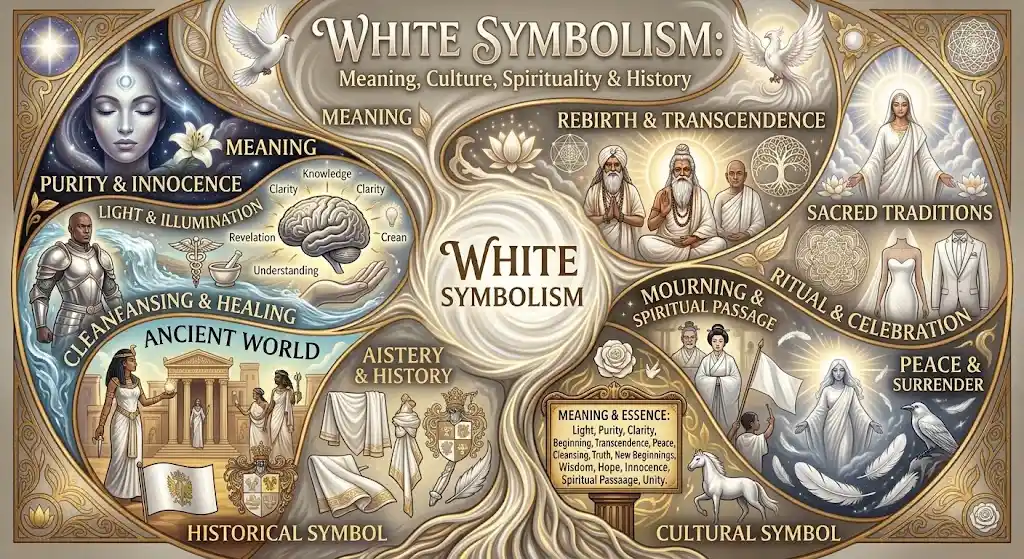
White symbolism reaches across religion, culture, history, dreams, nature, clothing, and design. This guide explains the most common meanings while showing why context matters.
Introduction
If you’re researching white symbolism, the most useful answer is not one fixed definition. White can suggest purity, peace, renewal, mourning, sacredness, simplicity, or surrender.
The meaning changes with culture, religion, history, object, and setting. This guide separates documented traditions from personal and modern interpretations, so you can understand white without forcing one meaning onto every situation.
Quick Answer
White symbolism commonly represents purity, innocence, peace, clarity, simplicity, spirituality, and new beginnings. In some cultures, white is also strongly connected with mourning and death.
TL;DR
- White often represents purity and clarity.
- White can symbolize peace and surrender.
- Religious meanings vary by tradition.
- White can represent mourning in some cultures.
- Weddings connect white with new beginnings.
- Dreams require personal context.
What Does White Symbolize?
White commonly carries meanings linked with purity, innocence, peace, clarity, simplicity, and renewal. These associations appear in religious ceremonies, clothing, weddings, art, design, and everyday life.
But color symbolism is learned through culture and context. The Smithsonian’s color research resources emphasize that color meaning can depend on historical and cultural circumstances. That makes “white always means purity” an unreliable rule.
The most common meanings include:
| Meaning | Common symbolic idea |
|---|---|
| Purity | Cleanliness or freedom from visible stain |
| Innocence | Simplicity or lack of corruption |
| Peace | Calm, reconciliation, or truce |
| New beginnings | A fresh chapter or open possibility |
| Spirituality | Sacredness or religious devotion |
| Clarity | Openness, light, or simplicity |
| Mourning | Grief or death in some traditions |
| Surrender | A request to stop conflict |
| Emptiness | A blank or unoccupied space |
| Sterility | Coldness or excessive cleanliness |
The right interpretation depends on what the white color is doing in its setting.
White Symbolism in Western Culture
In many Western settings, white has strong associations with weddings, religious ceremonies, cleanliness, peace, and celebration. These meanings are especially familiar in the United States.
White also appears in healthcare, formal clothing, architecture, and minimalist design. Those uses can reinforce ideas of cleanliness, order, openness, and professionalism.
Common Western associations include:
• Weddings and ceremonies
• Purity and innocence
• Peace and reconciliation
• Cleanliness and hygiene
• Religious celebration
• Fresh starts
• Formal clothing
• Minimalist spaces
These associations are widespread, but they are not universal rules.
White Symbolism in Asian Cultures
White can have a very different meaning in several Asian traditions. In parts of East and South Asia, white has long been connected with mourning, funerals, death, and spiritual transition.
The Library of Congress documents a historical Chinese funeral in San Francisco where white was used in Buddhist mourning dress. This provides a concrete example of why cultural context matters.
At the same time, Asia is not one symbolic culture.
• Chinese traditions can associate white with mourning.
• Japanese traditions can connect white with purity and sacred practice.
• Indian traditions include white mourning clothing.
• Family and regional customs can vary.
• Religious traditions can change the meaning.
• Modern communities may blend cultural practices.
• Diaspora communities can develop mixed customs.
• Historical meanings can change over time.
The safest interpretation is therefore specific rather than geographic.
White in Christianity and Other Religions
White has an established role in several religious traditions. In Roman Catholic practice, white is used during Easter and Christmas and for numerous celebrations connected with Christ, Mary, angels, and non-martyr saints.
This is different from simply saying that white “means holiness.” The actual tradition determines when and why the color is used.
White also has a place in Jewish practice. Some communities wear a white kittel on Yom Kippur. Explanations include purity, angelic imagery, mortality, repentance, and the solemn nature of the day.
Religious white symbolism can therefore include:
• Purity
• Sacred celebration
• Repentance
• Spiritual renewal
• Holiness
• Mortality
• Devotion
• Transformation
Religious symbolism should always be explained within the relevant tradition.
Spiritual Meaning of White
The spiritual meaning of white often centers on purity, peace, clarity, renewal, and sacredness. These associations appear in multiple spiritual traditions and modern symbolic practices.
However, spiritual symbolism is not the same as scientific evidence. If someone interprets white as a sign of spiritual protection, that should be presented as a belief or personal interpretation.
White may be interpreted spiritually as:
• Purification
• Inner clarity
• Peace
• Renewal
• Sacredness
• Hope
• Protection
• Spiritual awareness
• Transformation
• A fresh beginning
Your own spiritual tradition should guide interpretation when a specific religious practice is involved.
White Symbolism in Weddings
The modern Western white wedding dress has a specific historical story. Queen Victoria wore a white wedding dress when she married Prince Albert in 1840, helping popularize the style.
White weddings existed before Victoria, so it is inaccurate to say she invented the tradition. Historical wedding clothing varied by wealth, fashion, region, and period.
Today, white wedding clothing can symbolize:
• A new beginning
• Celebration
• Tradition
• Formality
• Purity
• Elegance
• Family expectations
• Personal style
Ivory, cream, champagne, and other shades are also common today. Their popularity shows that wedding symbolism continues to evolve.
White Symbolism in Mourning and Funerals
White can symbolize mourning as strongly as it can symbolize celebration. The difference comes from cultural and religious tradition.
In some traditions, white mourning clothing represents simplicity, purity, spiritual transition, or the state of the deceased. In other settings, black serves the primary mourning role.
This creates an important symbolic contrast:
White at a wedding may mark a new chapter.
White at a funeral may mark an ending or spiritual transition.
When interpreting funeral symbolism, consider:
• The culture involved
• The religious tradition
• The historical period
• The type of garment
• Other colors present
• The ceremony itself
• Local family customs
• The meaning assigned by participants
Never assume that a color has the same meaning at every ceremony.
White as a Symbol of Peace and Surrender
White is strongly connected with peace and conflict resolution. The white flag is widely recognized as a signal of surrender or a request for a truce.
That distinction matters. A white flag does not simply mean that someone feels peaceful. In a conflict setting, it communicates a specific intention to stop fighting or seek a cessation of hostilities.
White can therefore suggest:
• Peace
• Truce
• Reconciliation
• Surrender
• Nonviolence
• Calm
• Cooperation
• Resolution
The setting determines which interpretation is most appropriate.
White as a Symbol of New Beginnings
White can represent a new beginning because it visually suggests an open or untouched space. A blank page is one of the clearest everyday examples.
White also appears in ceremonies that mark transitions. A new marriage, baptism, celebration, or newly prepared space can use white to suggest a fresh stage.
Examples include:
• A blank white page
• A new white garment
• Fresh snow
• A newly painted room
• White ceremonial clothing
• White flowers at a celebration
• A new notebook
• A clean visual space
The symbolic idea is not that white automatically creates a new beginning. Rather, people use the color to express one.
White Symbolism in Dreams
Dream symbolism is personal. There is no reliable universal dictionary that can prove one meaning for every dream.
White may be interpreted as peace, clarity, innocence, renewal, emotional distance, or change. The meaning depends heavily on the dream’s setting and the dreamer’s feelings.
Ask these questions:
• What object was white?
• Did the color feel comforting or unsettling?
• Who else appeared?
• What happened before the white object appeared?
• Did the dream involve a real-life transition?
• Does your culture give white a special meaning?
• Did another color appear beside it?
• What emotion remained after waking?
This approach treats dream symbolism as reflection rather than prediction.
White in Nature and Everyday Life
White appears throughout nature, from snow and clouds to flowers, shells, feathers, and animals. People often attach symbolic meanings to these objects, but the meaning comes from the object and context together.
For example, a white flower at a wedding may suggest purity or celebration. The same flower at a memorial may communicate remembrance or sympathy.
Common associations include:
• White snow — quietness or renewal
• White clouds — openness or calm
• White flowers — purity, remembrance, or celebration
• White shells — simplicity or natural beauty
• White feathers — personal or spiritual symbolism
• White clothing — ceremony or cleanliness
• White candles — religious or symbolic use
• White animals — culturally specific symbolism
There is no single meaning for every white object.
White in Art, Design, and Clothing
Artists and designers use white to create space, contrast, simplicity, and visual focus. A white background can make darker elements stand out sharply.
White can also feel cold or sterile when used without warmth or texture. That is why its emotional effect depends on surrounding colors, materials, lighting, and composition.
White in modern visual culture can communicate:
• Minimalism
• Cleanliness
• Openness
• Simplicity
• Neutrality
• Precision
• Calmness
• Modernity
• Space
• Contrast
In clothing, white can feel formal, ceremonial, fresh, traditional, or highly casual depending on the garment and occasion.
White as Purity, Sterility, and Emptiness
One of the most interesting features of white symbolism is its ability to carry opposite ideas.
A white room can feel clean and peaceful. The same room can feel empty or cold when it lacks warmth and texture.
This creates useful symbolic contrasts:
| Positive association | Possible contrasting association |
|---|---|
| Purity | Sterility |
| Peace | Surrender |
| Simplicity | Emptiness |
| Clarity | Starkness |
| Freshness | Coldness |
| Innocence | Inexperience |
| Sacredness | Emotional distance |
| New beginning | Ending |
This does not mean white is positive or negative. It means symbolism changes with context.
How to Interpret White Symbolism Correctly
A good interpretation starts with evidence and context rather than a memorized color chart.
Use this process when you encounter white symbolism:
- Identify the object.
A white dress does not carry the same meaning as a white flag. - Identify the setting.
A wedding and funeral create very different symbolic expectations. - Identify the culture.
Cultural traditions can reverse common Western meanings. - Identify the religion.
Religious practices may assign specific meanings to white. - Consider history.
Symbolic meanings change over time. - Look at surrounding colors.
Color combinations can alter the visual message. - Consider personal emotion.
Personal symbolism can differ from cultural symbolism. - Avoid certainty when evidence is weak.
Symbolic interpretation often involves more than one reasonable reading.
This method produces a more responsible interpretation than saying “white always means purity.”
White Symbolism in Modern American Life
White remains highly visible in modern American culture. It appears in weddings, healthcare, home design, fashion, holidays, religious ceremonies, and branding.
A white wedding dress can represent tradition. A white medical coat can suggest cleanliness or professional authority. A white interior can create an open, minimalist feeling.
Common U.S. examples include:
• White wedding clothing
• White medical clothing
• White interior walls
• White religious garments
• White holiday decorations
• White flowers
• White formalwear
• White minimalist branding
Modern meanings often build on older traditions rather than replacing them.
White vs. Ivory, Cream, Gray, and Other Pale Colors
Not every pale color communicates the same visual message. White, ivory, cream, and pale gray can produce noticeably different impressions.
Bright white often feels crisp and clean. Ivory and cream usually feel warmer. Pale gray can feel quieter and more restrained.
A practical comparison:
| Shade | Common impression |
|---|---|
| Bright white | Crisp, clean, open |
| Ivory | Warm, traditional, soft |
| Cream | Gentle, comfortable, warm |
| Pale gray | Restrained, neutral, quiet |
| White-blue | Cool, calm, spacious |
| White-gold | Celebratory, refined |
| White-green | Fresh, natural |
| White-black | Strong, formal contrast |
These are visual associations, not universal symbolic laws.
How Other Colors Change White’s Meaning
White often works as a supporting color. The color beside it can influence how the overall combination feels.
White and black can create strong contrast and formality. White and blue can suggest coolness or calm in many design contexts. White and gold can feel celebratory or luxurious.
Examples include:
• White + black — contrast and formality
• White + blue — calm or coolness
• White + green — freshness or nature
• White + gold — celebration or refinement
• White + red — strong visual contrast
• White + purple — ceremonial or spiritual associations
• White + pink — softness or celebration
• White + gray — restraint and minimalism
The exact meaning still depends on culture, design, and context.
White Symbolism: Cultural Meaning vs. Personal Meaning
Cultural symbolism and personal symbolism are not the same thing.
A culture may associate white with mourning, while one person may associate it with weddings. Both associations can exist without one automatically canceling the other.
When interpreting a personal symbol, ask:
• What does the color mean in the person’s culture?
• What does the object represent?
• What memory is connected to it?
• What emotions does it create?
• Is there a religious meaning?
• Is there a historical meaning?
• Is the interpretation shared by others?
• Is it simply a personal association?
This distinction is especially useful for dreams, artwork, tattoos, gifts, and personal rituals.
FAQs
What is the main symbolism of white?
White commonly represents purity, innocence, peace, clarity, simplicity, and new beginnings. In some cultures, it also represents mourning, death, or spiritual transition.
Is white always a symbol of purity?
No. Purity is one major association, especially in many Western and religious contexts. White can also suggest mourning, emptiness, surrender, sterility, or coldness.
Why is white used for weddings?
In Western culture, white wedding dresses became especially popular after Queen Victoria’s 1840 wedding. The color later became strongly connected with bridal tradition, celebration, and new beginnings.
Does white symbolize death?
In some cultures, yes. White is used in mourning and funeral traditions in parts of Asia and can symbolize death, grief, simplicity, or spiritual transition.
What does white symbolize spiritually?
Depending on the tradition, white can represent purity, sacredness, peace, renewal, repentance, or spiritual clarity. These meanings should be attributed to the relevant belief system rather than treated as scientific facts.
What does white mean in dreams?
White in a dream can be interpreted in several ways, including peace, clarity, innocence, renewal, or emotional distance. The dreamer’s feelings and the surrounding imagery are more useful than a fixed definition.
What does a white flag symbolize?
A white flag commonly signals surrender or a request for a truce. It is closely associated with peace but has a more specific meaning in conflict situations.
Conclusion
White symbolism is not a single definition. The color can represent purity, peace, spirituality, renewal, mourning, simplicity, surrender, or even emptiness.
The best interpretation comes from context. Look at the culture, religion, object, setting, historical period, surrounding colors, and personal meaning before deciding what white represents. When those factors are considered together, white becomes a much richer and more accurate symbol to understand.