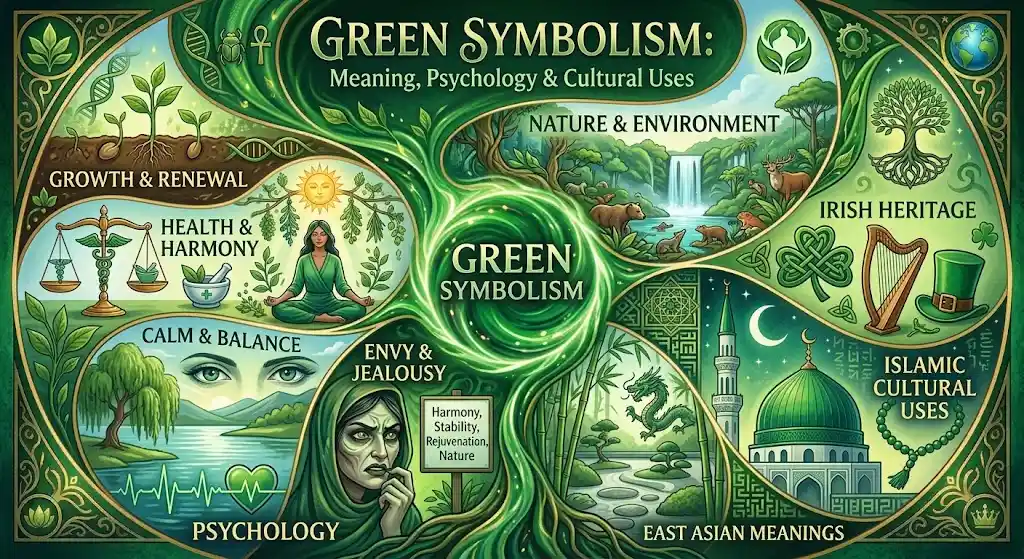
If you’re exploring green symbolism, this guide explains what the color can represent and why. Green commonly connects with nature, life, growth, renewal, balance, and hope.
Its meaning can also change with the setting. Green may suggest money, prosperity, safety, envy, spirituality, youth, or inexperience. Culture, shade, history, and surrounding symbols all influence its meaning. Color Psychology
Quick Answer
Green symbolism most often represents nature, life, growth, renewal, balance, and vitality. In some settings, it can also represent money, prosperity, safety, envy, spirituality, or inexperience.
TL;DR
- Green strongly connects with nature and living things.
- Growth and renewal are major green meanings.
- Green can symbolize money in American culture.
- Envy gives green a well-known negative meaning.
- Religious meanings vary between traditions.
- Shade and context can change the message.
Green Symbolism: Core Meaning and Definition
Green is closely tied to living landscapes. Leaves, grass, moss, and forests make the association feel immediate and natural. This is why green often represents life, growth, and renewal.
The color can also suggest balance and harmony. These meanings are common, but they aren’t universal rules. The setting always helps determine the intended message. Color Psychology
- Nature: connection with plants, forests, and the natural world
- Growth: development, progress, and becoming stronger
- Renewal: fresh starts and returning life
- Hope: improvement after a difficult period
- Balance: harmony between different forces
- Vitality: energy, life, and freshness
- Prosperity: wealth or abundance in some settings
- Envy: jealousy in English-language expressions
Green Symbolism in Nature
Nature provides the strongest foundation for green symbolism. Fresh leaves appear during growth, while green landscapes can signal an active growing season.
Historical art traditions also connected green with life, spring, nature, and renewal. This connection helps explain why green remains one of the most recognizable symbols of natural growth. Color Psychology
- Spring greenery can represent renewal.
- New leaves can suggest fresh beginnings.
- Forest green can suggest stability and depth.
- Grass can represent vitality and natural abundance.
- Moss can suggest age, patience, and quiet growth.
- Green gardens can symbolize nourishment and life.
- Rain-fed landscapes can suggest restoration.
- Evergreen plants can suggest continuity.
Positive Meanings of Green
Green has many positive associations because it resembles healthy vegetation. A green landscape can visually suggest that life is active and conditions are favorable.
Common positive meanings include hope, harmony, growth, health, freshness, prosperity, and renewal. Their strength depends on the setting. What Color Is This?
- Growth after a difficult period
- Hope for future progress
- Harmony within relationships
- Freshness and new energy
- Connection with nature
- Prosperity and abundance
- Renewal after change
- Calm and balance
- Vitality and life
Negative Meanings of Green
Green doesn’t always carry a positive message. English uses green in expressions connected with envy and inexperience.
The phrase “green with envy” gives green a strong emotional association. The word “greenhorn” also uses green to suggest someone inexperienced. MeaningVs
- Envy: wanting what another person has
- Jealousy: emotional comparison or resentment
- Greed: excessive desire for wealth
- Inexperience: being new to something
- Sickness: a pale or sickly green impression
- Immaturity: something not fully developed
- Stagnation: a dull green setting may suggest lack of change
- Toxicity: unnatural green can suggest danger in artistic contexts
These meanings shouldn’t be treated as universal. Context decides whether green feels healthy, hopeful, threatening, or negative.
Spiritual Meaning of Green
Green often appears in spiritual symbolism because of its connection with life and renewal. Modern spiritual traditions may associate it with healing, compassion, balance, hope, and growth.
However, spiritual interpretations differ widely. A personal spiritual association shouldn’t be presented as a universal religious rule. The Color Atlas
- Growth of the inner self
- Renewal after hardship
- Connection with nature
- Compassion and care
- Emotional balance
- Hope and restoration
- Life and vitality
- Harmony with the natural world
Green in Christianity
Green has a recognized place in Christian liturgical tradition. It is commonly connected with periods of continuing spiritual growth and ordinary life.
Historical Christian symbolism also linked green with life, spring, and rebirth. The exact interpretation can differ among denominations and traditions.
It’s better to describe green as an established symbolic color in Christian practice rather than assign one meaning to every Christian group.
Green in Islam
Green has an important place in Islamic history and visual culture. Islamic sources and art traditions have associated green with life, paradise, and spiritual significance.
Green also appears widely in Islamic art and in the visual identity of several Muslim-majority societies. Its meaning should still be understood within the specific cultural or religious context. Color Psychology
Green in Chinese Culture
Green has positive associations with nature, spring, growth, and renewal in many Chinese cultural contexts. However, one well-known expression creates a very different meaning.
The green-hat association is a cultural taboo connected with marital infidelity. This is a useful example of why color symbolism cannot be reduced to one universal definition. Color Psychology
For a general audience, the key lesson is simple: green can carry positive meanings while still having specific negative meanings in particular contexts.
Green in Irish and Celtic Tradition
Green is strongly connected with Irish identity and St. Patrick’s Day. The color can suggest landscape, national identity, celebration, folklore, and historical movements.
This makes Irish green symbolism different from simply saying that green means “nature.” The cultural setting adds another layer of meaning.
Green Psychology and Emotions
People often describe green as calming, balanced, refreshing, or restful. These impressions are common, but they shouldn’t be treated as automatic psychological effects.
Color responses can vary with culture, personal experience, shade, brightness, and context. Green may feel peaceful in one setting and energetic in another. Color Psychology
- Soft greens can feel gentle and fresh.
- Forest greens can feel stable and grounded.
- Bright greens can feel energetic.
- Yellow-green can feel lively or unusual.
- Blue-green can feel cooler and quieter.
- Dark green can feel mature or serious.
- Muted green can feel natural and understated.
- Neon green can feel playful or intense.
Meaning of Different Green Shades
Not every green communicates the same impression. Shade, brightness, saturation, and surrounding colors can change how green is interpreted.
This makes shade especially useful in design, clothing, art, and symbolic imagery. The Color Atlas
- Sage green: calm, earthy, understated
- Mint green: freshness, softness, cleanliness
- Emerald green: richness, vitality, luxury
- Forest green: nature, depth, stability
- Olive green: earthiness, maturity, restraint
- Lime green: energy, youth, boldness
- Dark green: maturity, stability, wealth
- Pale green: freshness, beginnings, softness
These are interpretive associations, not fixed definitions.
Green in Money, Success, and Prosperity
In the United States, green has a strong connection with money because of the appearance of U.S. currency. This gives the color a financial meaning that is especially noticeable in American settings.
Green can therefore suggest wealth, prosperity, financial growth, or abundance. Yet this meaning is culturally specific rather than universal. What Color Is This?
A green design for a financial service may feel different from green used for a garden brand. The first may emphasize money and stability. The second may emphasize nature and sustainability.
Green in Literature, Dreams, and Stories
Writers often use green because its meaning can shift with the story. A green landscape may suggest youth or renewal, while a green object may suggest jealousy or inexperience.
Dream symbolism is even more personal. There is no reliable universal rule saying that seeing green in a dream always means one specific thing.
When interpreting green in a story or dream, consider:
- What shade of green appears?
- What object carries the color?
- What emotion surrounds it?
- Is the scene healthy or unsettling?
- What happens before and after the green appears?
- Does the story establish its own symbolism?
- Does the dream connect to a personal memory?
- Are other colors reinforcing the message?
Green in Everyday Life and Design
Green appears in many practical settings. Traffic systems use green to communicate permission to proceed, while environmental campaigns often use it to suggest nature or sustainability.
Designers also use green in interiors, clothing, packaging, gardens, and branding. The meaning depends on the shade and surrounding visual choices. What Color Is This?
For example, a deep green room may feel grounded and traditional. A bright lime accent can feel much more energetic.
How to Interpret Green Symbolism Correctly
The best way to interpret green is to start with context. Don’t select a meaning simply because it appears on a symbolism list.
Ask what the color is doing in that particular situation.
- Identify the object that is green.
- Note the exact shade.
- Consider the surrounding colors.
- Identify the emotional tone.
- Check the cultural setting.
- Consider the historical period.
- Look for nearby symbolic objects.
- Compare positive and negative meanings.
- Avoid assuming one meaning is universal.
- Use the strongest meaning supported by context.
This approach works better than memorizing dozens of isolated definitions.
Common Green Symbolism Mistakes
The biggest mistake is assuming green always means growth. Growth is common, but green also has meanings connected with money, envy, religion, culture, and inexperience.
Another mistake is treating modern spiritual interpretations as established religious doctrine. Religious symbolism should be tied to the specific tradition being discussed.
Avoid these common errors:
- Treating one culture’s meaning as universal
- Calling green automatically calming
- Assuming green always means good luck
- Treating dream meanings as predictions
- Ignoring the shade of green
- Ignoring the surrounding symbols
- Confusing symbolism with scientific fact
- Using historical claims without reliable sources
FAQs
What does green symbolize?
Green most commonly symbolizes nature, life, growth, renewal, and balance. Depending on context, it can also represent money, safety, envy, spirituality, or inexperience.
What does green symbolize spiritually?
Green can symbolize renewal, life, harmony, compassion, and growth in spiritual contexts. The exact meaning depends on the religious or spiritual tradition.
Is green a positive or negative color?
Green can be either. Nature and growth create positive associations, while envy, greed, and inexperience create negative ones.
Why does green symbolize envy?
The association comes mainly from English-language expressions such as “green with envy.” It is a cultural and linguistic association rather than a universal psychological rule.
What does dark green symbolize?
Dark green often suggests nature, maturity, stability, depth, or wealth. Its impression changes with the setting and other colors around it.
What does green mean in dreams?
There is no single universal meaning for green in dreams. Personal feelings, memories, the shade, and the dream’s setting provide better clues.
What does green symbolize in different cultures?
Green can represent nature and renewal in many cultures, while specific traditions give it additional meanings. Islamic, Irish, Chinese, and Western contexts provide different examples. Color Psychology
Conclusion
Green symbolism is powerful because the color connects directly with the living world. It can represent nature, growth, renewal, hope, balance, prosperity, spirituality, or even envy.
The safest interpretation considers context, culture, shade, emotion, and surrounding symbols. Use those clues together instead of relying on one fixed definition. For your next symbolism question, start by identifying what the color is doing in the scene.