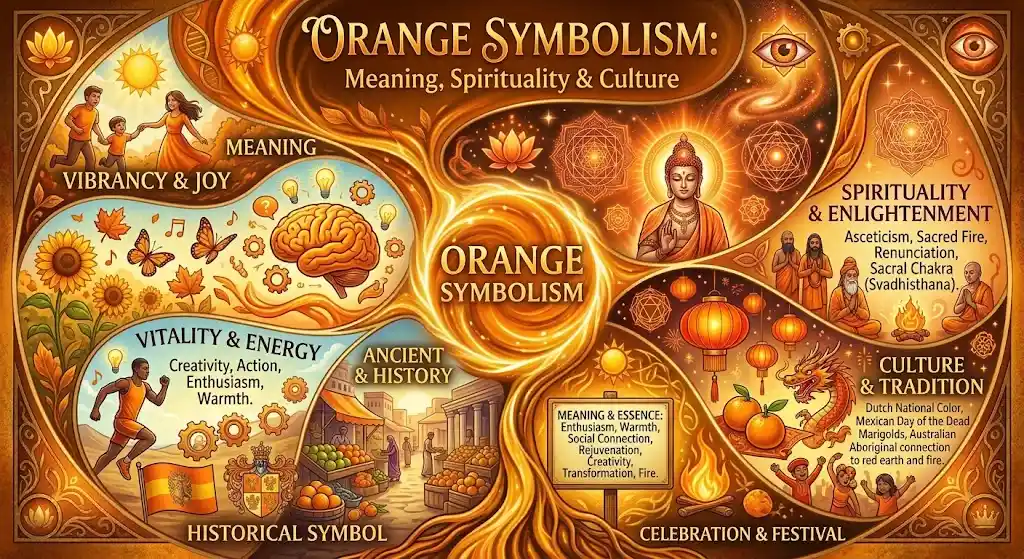
If you’re exploring orange symbolism, this guide helps you understand its meaning without treating one interpretation as universal. Orange commonly suggests warmth, energy, creativity, enthusiasm, and attention.
Its meaning changes with context. A pumpkin can suggest autumn, while a safety vest signals visibility. Saffron clothing may carry religious meaning, while burnt orange can create a grounded mood in a room.
Quick Answer
Orange symbolism commonly represents warmth, energy, creativity, enthusiasm, confidence, and attention. Its meaning changes with shade, setting, culture, object, and personal experience.
TL;DR
- Orange often represents energy and warmth.
- Bright orange can attract attention.
- Orange strongly connects with autumn in America.
- Saffron carries religious meanings in some traditions.
- Dreams require personal context.
- Shade can change symbolic meaning.
Orange Symbolism: Core Meaning
Orange sits between red and yellow, which helps explain its energetic visual character. It can feel active like red while remaining brighter and more approachable.
Common orange symbolism includes warmth, enthusiasm, creativity, confidence, movement, and social energy. Orange can also suggest caution when used for visibility or safety.
The meaning becomes clearer when you ask what the orange object represents. A flame, flower, fruit, shirt, sign, and sunset can all carry different messages.
• Warmth: orange recalls sunlight, fire, and cozy autumn scenes.
• Energy: bright orange can suggest movement and activity.
• Creativity: orange often appears in playful and expressive designs.
• Confidence: strong orange can communicate bold self-expression.
• Attention: vivid orange naturally stands out in many environments.
• Abundance: fruit and harvest imagery can connect orange with plenty.
• Transformation: fire and changing autumn leaves support this interpretation.
• Caution: safety orange has a practical attention-focused meaning.
Orange in American Culture
In the United States, orange has a strong connection with autumn, pumpkins, Halloween, harvests, sports, and outdoor activity. These associations come from repeated seasonal and everyday experiences.
Autumn is especially important because changing leaves reveal bright orange and yellow pigments after green chlorophyll declines. Pumpkins add another strong orange image to the American fall season.
• Autumn: seasonal change and natural beauty.
• Halloween: pumpkins, decorations, costumes, and nighttime imagery.
• Harvest: ripeness, abundance, and seasonal completion.
• Sports: energy, team identity, confidence, and visibility.
• Food: citrus, pumpkin, carrots, and other orange foods.
• Outdoor life: adventure, movement, and activity.
• Sunsets: warmth, reflection, and transition.
• Home decor: comfort, earthiness, and seasonal warmth.
Orange Spiritual Meaning
In modern spiritual symbolism, orange is often connected with vitality, creativity, emotional expression, transformation, and enthusiasm. These meanings are interpretive rather than universal rules.
The spiritual meaning can also depend on the tradition involved. A bright orange object in a personal meditation practice does not automatically carry the same meaning as saffron clothing in a religious setting.
Some common spiritual interpretations include:
• Creativity: expressing ideas and personal energy.
• Vitality: feeling active, motivated, or engaged.
• Transformation: moving from one stage of life to another.
• Emotional expression: allowing feelings to be acknowledged.
• Courage: choosing action instead of remaining passive.
• Connection: encouraging warmth and social openness.
• Renewal: beginning a fresh phase.
• Devotion: relevant in some religious color traditions.
These meanings should be treated as frameworks for reflection, not predictions about the future.
Orange in Hindu and Buddhist Traditions
Saffron and ochre shades have important religious associations in South Asian traditions. They should not simply be treated as interchangeable with every modern use of bright orange.
In Hindu contexts, saffron can be connected with religious devotion, sacrifice, spiritual discipline, and renunciation. In Buddhist traditions, saffron and ochre robes are strongly associated with monastic life, although shades and practices differ across schools and regions.
This makes cultural context essential. Calling every orange object “sacred” would erase the specific history behind these traditions.
The better approach is to identify the tradition, shade, object, and setting before assigning meaning.
Orange in Christianity and Biblical Context
Orange does not have one simple, universally accepted biblical meaning. Many modern interpretations connect orange with imagery such as fire, light, warmth, endurance, or spiritual intensity.
That distinction matters because biblical symbolism often comes from objects and images rather than modern color charts. Fire may have symbolic significance in scripture, but that does not mean every orange object automatically carries the same message.
When interpreting orange in a Christian context:
• Look at the biblical image involved.
• Identify whether fire, light, or another symbol is present.
• Check the surrounding passage.
• Avoid assigning modern color meanings directly to scripture.
• Separate biblical text from later devotional interpretations.
• Consider the church tradition and teaching context.
This approach produces a more careful interpretation than saying “orange means one thing in the Bible.”
Orange in Dreams and Personal Symbolism
Dreams involving orange can feel vivid because orange is visually strong. Popular interpretations often connect it with energy, creativity, confidence, change, or emotional warmth.
Still, dream symbolism is personal. The same orange sunset could feel peaceful in one dream and unsettling in another. Your emotion and the surrounding events matter as much as the color.
Consider these examples:
• Orange clothing: self-expression, confidence, or visibility.
• Orange sunset: transition, reflection, or closure.
• Orange fruit: nourishment, pleasure, or abundance.
• Orange fire: intensity, change, or strong emotion.
• Orange animal: the animal’s symbolism may matter more than its color.
• Orange room: atmosphere, comfort, stimulation, or personal memory.
The safest method is to ask, “What did orange mean to me in this specific dream?”
Orange in Psychology and Emotions
Color psychology can help explain why orange often feels warm or energetic, but it should not be used to diagnose personality.
Research has found meaningful relationships between color and emotional perception. Some studies have linked orange with positive emotional concepts, while other findings show that context changes the response.
Orange can therefore suggest:
• warmth
• activity
• enthusiasm
• friendliness
• excitement
• creativity
• attention
• playfulness
However, people do not respond to color in exactly the same way. Culture, experience, brightness, saturation, surrounding colors, and personal preference can all influence perception.
Orange Personality Meaning
Popular color symbolism often describes people attracted to orange as expressive, adventurous, social, energetic, and confident.
These descriptions can be useful for reflection, but they are not personality tests. Choosing orange does not prove that someone has a particular personality type.
A more balanced interpretation might look like this:
Possible strengths: enthusiasm, openness, creativity, confidence, spontaneity.
Possible challenges: impatience, overstimulation, impulsiveness, or a desire for attention.
The meaning also depends on the shade. Someone drawn to muted terracotta may be responding to its earthy warmth rather than the intensity associated with neon orange.
Orange in Love and Relationships
Orange can symbolize attraction, warmth, playfulness, confidence, and emotional energy in relationship symbolism.
It often feels less formal than dark red and more energetic than soft yellow. That makes it useful as a symbolic color for excitement and new experiences.
In relationship contexts, orange may suggest:
• attraction
• enthusiasm
• playful communication
• confidence
• emotional warmth
• adventure
• fresh beginnings
• social connection
These are symbolic associations, not predictions. A person’s behavior and communication matter far more than the color they wear or choose.
Orange in Nature, Autumn, and Harvest
Nature gives orange some of its strongest symbolic associations. Autumn leaves, pumpkins, citrus fruit, flowers, sunsets, and fire all provide familiar orange images.
Autumn is especially powerful because orange appears during a visible seasonal transition. As chlorophyll breaks down, yellow and orange pigments that were already present in leaves become easier to see.
This creates several common symbolic themes:
• Change: the season is visibly shifting.
• Harvest: crops reach maturity.
• Abundance: ripe fruit suggests plenty.
• Completion: a growing season moves toward its end.
• Warmth: orange recalls sunlight and fire.
• Beauty: change can be visually meaningful.
• Renewal: one season ends before another begins.
• Impermanence: natural beauty does not remain unchanged.
Orange as a Symbol of Safety and Attention
Orange has a very practical symbolic role: visibility.
U.S. transportation guidance uses orange extensively in work zones and high-visibility safety materials. Fluorescent orange can increase conspicuity during daytime conditions, helping objects and workers stand out.
This is different from emotional symbolism. A construction cone does not necessarily mean “creativity.” Its orange color helps communicate notice this area.
Orange can therefore represent:
• caution
• attention
• visibility
• temporary hazards
• work zones
• boundaries
• direction
• protection through visibility
The object and environment determine the message.
Meaning of Different Orange Shades
Orange has a wide range of shades, and they don’t all create the same impression.
Bright orange often feels energetic, youthful, bold, and attention-grabbing.
Tangerine can feel playful, fresh, and expressive.
Peach is softer and may suggest friendliness, gentleness, or comfort.
Amber can feel warm, glowing, mature, and rich.
Burnt orange often suggests autumn, earthiness, nostalgia, and maturity.
Rust can create an older, grounded, natural feeling.
Terracotta often feels earthy, handcrafted, warm, and domestic.
Fluorescent orange is strongly connected with visibility and safety.
The shade should therefore be considered before interpreting orange symbolism.
Orange in Art, Design, and Branding
Orange is useful in visual design because it can attract attention while maintaining a warm character.
Bright orange can create excitement, while muted orange can create a calmer and more grounded atmosphere. The surrounding colors also influence how orange is perceived.
For example:
• Orange + black can suggest Halloween or strong contrast.
• Orange + blue creates a bold visual contrast.
• Orange + cream feels softer and warmer.
• Orange + brown feels earthy and autumnal.
• Orange + green can emphasize nature.
• Peach + white can feel gentle.
• Burnt orange + beige can feel traditional.
• Orange + dark gray can feel modern and energetic.
The key lesson is that orange does not work alone. Color relationships influence symbolic meaning.
Orange Across Cultures and Traditions
Orange does not have one worldwide definition.
In parts of South and Southeast Asia, saffron and ochre have religious associations. In the Netherlands, orange has a strong connection with national and royal identity through the House of Orange. In the United States, orange is strongly tied to autumn, Halloween, harvest imagery, and visibility.
These examples show why cultural context matters.
A symbol can mean:
• religious devotion in one setting
• national identity in another
• seasonal celebration somewhere else
• safety and visibility in a work zone
• creativity in a design
• personal confidence in clothing
Never assume that a meaning from one culture applies everywhere.
Positive and Negative Orange Symbolism
Orange has both positive and negative associations.
Its positive side often includes warmth, enthusiasm, creativity, confidence, joy, sociability, abundance, and movement.
Its negative side may appear when orange becomes excessive, aggressive, distracting, or overly intense.
| Positive association | Possible negative association |
|---|---|
| Energy | Restlessness |
| Creativity | Impulsiveness |
| Warmth | Overstimulation |
| Confidence | Attention-seeking |
| Enthusiasm | Impatience |
| Abundance | Excess |
| Sociability | Loudness |
| Transformation | Uncertainty |
Neither side is automatically correct. The surrounding context determines which interpretation makes more sense.
How to Interpret Orange Symbolism Responsibly
The best way to interpret orange is to avoid using a fixed dictionary definition. Instead, examine the complete situation.
Start with the object. Orange on a pumpkin differs from orange on a warning sign. Then examine the shade, because peach and fluorescent orange create very different impressions.
Next, consider the setting and culture. A saffron robe should be interpreted within its religious tradition rather than through a generic color chart.
Finally, consider the emotion and purpose. Ask what the orange object is doing in the scene and how it makes you feel.
A useful interpretation checklist is:
• What object is orange?
• Which shade of orange appears?
• Where does it appear?
• What culture or tradition is involved?
• What other colors surround it?
• What emotion does the scene create?
• Is the orange decorative, practical, religious, seasonal, or symbolic?
• Is there a specific personal memory connected to it?
This approach makes orange symbolism more accurate, thoughtful, and useful.
FAQs
What does orange symbolize most often?
Orange commonly symbolizes warmth, energy, enthusiasm, creativity, confidence, and attention. Its exact meaning depends on context.
Is orange a positive or negative symbol?
It can be either. Orange often has positive associations with energy and warmth, but intense orange can suggest caution, urgency, or excess in some settings.
What does orange symbolize spiritually?
Some spiritual traditions associate orange with vitality, creativity, transformation, devotion, or emotional expression. These meanings vary by tradition and should not be treated as universal facts.
What does orange symbolize in dreams?
Orange in dreams may be interpreted through themes such as energy, creativity, change, or emotional expression. The dream’s setting and your feelings are more useful than the color alone.
Why is orange associated with Halloween?
In the United States, pumpkins, autumn leaves, harvest imagery, and seasonal decorations helped establish orange as a major Halloween color.
Why is orange used for safety?
Bright and fluorescent orange is highly visible and is widely used in work-zone and safety applications. Its practical meaning is usually attention and visibility rather than emotion.
What does burnt orange symbolize?
Burnt orange often feels more earthy and mature than bright orange. It can suggest autumn, warmth, nostalgia, stability, and natural change.
Conclusion
Orange symbolism is best understood as a flexible set of meanings rather than one fixed definition. Warmth, energy, creativity, confidence, transformation, visibility, and seasonal change are among its strongest associations.
The most reliable interpretation considers the shade, object, setting, culture, purpose, and emotion together. When you look at all six factors, orange becomes easier to understand without forcing one meaning onto every situation.