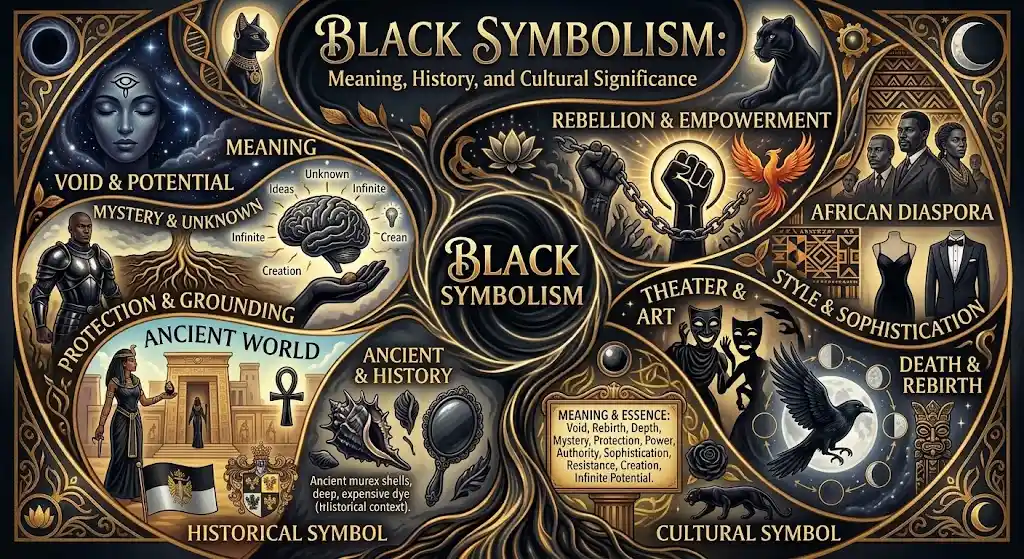
If you’re exploring black symbolism, this guide explains what black can represent and why its meaning changes across cultures. You’ll find historical, spiritual, religious, artistic, and everyday examples.
Black can suggest mystery, mourning, authority, elegance, protection, or transformation. Yet no single meaning works in every situation. The object, culture, setting, emotion, and purpose all shape the interpretation.
Quick Answer
Black symbolism commonly represents mystery, power, mourning, elegance, authority, and the unknown. In some traditions, it can also represent protection, fertility, transformation, or spiritual depth.
TL;DR
• Black often represents mystery and the unknown.
• It can communicate authority and formal power.
• Mourning is a major Western association.
• Spiritual meanings depend on belief systems.
• History changes how black is understood.
• Context should guide every interpretation.
What Does Black Symbolism Mean?
Black symbolism is the collection of ideas and meanings people attach to black. These meanings come from culture, history, religion, art, fashion, language, and personal experience.
The key point is simple: black has no single universal symbolic meaning. A black dress, black ribbon, black flower, and black sky can communicate very different ideas.
For example, black clothing at a funeral may express grief. A black suit at a formal event may communicate authority or elegance.
A useful interpretation starts with the complete symbol rather than the color alone.
• Mystery can relate to hidden or unknown things.
• Power can suggest authority, control, or strength.
• Mourning can communicate grief and solemn remembrance.
• Elegance can come from black’s restrained visual quality.
• Protection appears in some cultural and spiritual traditions.
• Transformation can represent an ending or transition.
• Independence can appear through personal fashion and identity.
• Depth can suggest seriousness, reflection, or emotional weight.
The Main Meanings of Black
Black is unusual because many of its symbolic meanings appear to contradict one another. It can represent loss and strength, darkness and elegance, endings and potential.
That does not make the symbolism inconsistent. It shows that color meaning develops from human experience and cultural use.
Mystery and the Unknown
Black is closely connected with darkness. Darkness limits visibility, so black naturally works as a symbol for hidden things and uncertainty.
Power and Authority
Black can communicate authority through formal clothing, uniforms, institutional settings, and visual design.
Mourning and Remembrance
In many Western settings, black clothing is strongly associated with funerals and grief.
Elegance and Sophistication
Modern fashion often uses black for formal, restrained, and refined appearances.
Protection
Some spiritual traditions use black symbolically for boundaries, shielding, or protection. This is a belief-based meaning rather than a scientific property of the color.
Transformation
Black can symbolize an ending, transition, or period of change. The interpretation becomes stronger when other symbols support that theme.
Why Black Has Positive and Negative Meanings
Black is sometimes described as either positive or negative. That approach is too simple.
A black funeral suit can represent respect. A black luxury package can represent refinement. A black storm cloud may suggest danger or uncertainty.
The color stays the same while the context changes.
When interpreting black, ask five questions:
• What is black?
• Where does it appear?
• Which culture or tradition is involved?
• What emotion surrounds it?
• Why was black chosen?
This method prevents one of the biggest symbolism mistakes: assigning a fixed meaning to every appearance of the color.
Black Symbolism Through History
Black has a long history in art and social life. Early humans used black pigments made from materials such as charcoal and minerals.
Black later became important in painting, writing, clothing, religion, and ceremony. Its meanings changed as societies changed.
European history provides a clear example. Black was connected with darkness, death, and humility during parts of the medieval period. Later, refined black clothing became associated with authority, wealth, courts, and formal status.
Black therefore cannot be separated from social history. The meaning of a color develops through how people use it.
Historical research on black also shows its remarkable duality. It has represented both humility and authority, mourning and luxury, sin and religious devotion.
Black Symbolism in Ancient Egypt
Ancient Egypt provides one of the clearest examples of why black should not automatically mean death or evil.
The dark soil associated with the Nile was connected with agricultural fertility and renewal. Black could therefore carry associations with life, regeneration, and the productive earth.
Black also appeared in funerary and religious contexts. This created a more complex relationship between life, death, regeneration, and the afterlife.
The important lesson is not that “Egyptians believed black was good.” It is that black could carry meanings that included fertility, regeneration, and the afterlife.
That complexity is easy to lose when color symbolism is reduced to one-word definitions.
Black Symbolism in Chinese Culture
Traditional Chinese color systems provide another useful example.
Within the Five Phases framework, black is associated with Water, the north, and winter. These associations belong to a larger cosmological system rather than a simple good-versus-bad color chart.
Black also had political importance during the Qin dynasty. The color appeared in official contexts connected with the dynasty’s understanding of cosmological order.
Chinese ink art adds another meaning. Black ink can communicate line, texture, distance, movement, and tonal depth.
This shows why “black means bad luck in China” is an unreliable generalization. The meaning changes with historical and cultural context.
Black Symbolism in Japan and Other Cultures
Japanese uses of black have included associations with mystery, formality, strength, darkness, and the unknown. The exact meaning depends on the historical and social setting.
Other traditions may connect black with mourning, authority, maturity, ancestry, sacred power, or protection.
These differences are important because color symbolism is not a universal dictionary.
Even within one country, black can mean different things in:
• clothing
• religious ceremonies
• artwork
• language
• folklore
• political imagery
• family traditions
• modern fashion
A strong interpretation therefore identifies the specific tradition before assigning meaning.
Black Symbolism in Religion and Spirituality
Black appears in many religious and spiritual traditions, but its meaning varies considerably.
In Christian history, black has been associated with mourning, penitence, solemnity, and human mortality in different settings. Biblical references to blackness and darkness also require passage-specific interpretation.
In Hindu traditions, Kali is commonly depicted with a dark or black appearance. Her symbolism involves destruction, time, transformation, and the removal of harmful forces.
Modern spiritual traditions may associate black with protection, grounding, introspection, hidden knowledge, or transformation.
These modern interpretations should be presented as beliefs or symbolic frameworks, not as universal facts.
That distinction makes spiritual symbolism more respectful and accurate.
Black as Mourning, Death, and Remembrance
Black is strongly associated with mourning in many Western societies, including the United States.
Black funeral clothing can communicate grief, respect, seriousness, and restraint. The color has become a familiar visual language for solemn occasions.
Black can also symbolize death in literature, art, religion, and folklore. Yet the color itself does not automatically mean literal death.
Sometimes black represents:
• grief after a loss
• the closing of a chapter
• remembrance
• emotional seriousness
• silence
• separation
• an ending
• uncertainty about what comes next
The surrounding symbol determines which interpretation makes the most sense.
Black as Power, Authority, and Elegance
Black is often used when a visual message needs to feel controlled or formal.
A black suit can suggest professionalism. A black uniform can communicate authority. A black evening dress can communicate elegance.
Modern design uses the same principle. Black can make a product, room, logo, or package appear restrained and sophisticated.
Historical European clothing also demonstrates how black became associated with power and social status. Black was not always an expensive or prestigious choice, but later developments in dyeing and fashion helped change its social meaning.
So when black represents power, the meaning often comes from social use, not from the color acting as a natural source of power.
Black as Mystery, Protection, and the Unknown
Mystery is one of the easiest meanings to understand. Black visually conceals details, especially when associated with darkness.
Protection is more context-dependent. Some spiritual and cultural systems use black symbolically as a boundary or shield.
The important distinction is that symbolic protection is different from a physical protective property.
When you see black used as a protective symbol, consider:
• the tradition behind the practice
• the object carrying the color
• the ceremony or setting
• the person’s belief system
• the intended symbolic message
• whether the source is historical or modern
This prevents spiritual interpretations from being presented as universal truths.
Black as Transformation and New Beginnings
Black can represent transformation because darkness often appears in stories about uncertainty, endings, and change.
The meaning becomes especially strong when black appears with symbols of doors, roads, seasons, death, rebirth, seeds, or renewal.
A black image does not automatically predict a future transformation. Symbolism is better used as a tool for reflection than prediction.
For example, a black door could suggest an unknown opportunity in one story. In another, it could simply be a design choice.
The surrounding story decides the meaning.
What Does Wearing Black Symbolize?
Wearing black can communicate different ideas depending on the occasion and the person.
At a funeral, it may communicate grief and respect. At a business event, it may communicate formality and authority. In everyday fashion, it may simply reflect personal taste.
Possible meanings include:
• Formality: black works naturally in formal settings.
• Authority: dark clothing can create a serious visual impression.
• Elegance: black is widely used in formal fashion.
• Privacy: some people prefer its understated appearance.
• Mourning: black remains common in Western funeral traditions.
• Individuality: black can become part of a personal style.
• Simplicity: black can reduce visual complexity.
• Personal preference: sometimes black has no deeper symbolic meaning.
The safest approach is not to assume someone’s personality from their clothing color.
Black Symbolism in Dreams, Flowers, and Everyday Objects
Black becomes especially interesting when it appears as part of another symbol.
A black flower is different from the color black by itself. A black bird is different from a black room. A black ribbon is different from black clothing.
Dreams require even more caution because personal associations matter.
A black room might represent uncertainty for one person. For another, it might simply reflect a familiar place from memory.
A useful dream interpretation asks:
• What object or scene was black?
• What happened before and after it?
• What emotion did you feel?
• Did the black imagery feel safe or threatening?
• Does the symbol have cultural meaning?
• Is there a personal memory attached to it?
The same method works for everyday objects.
Black Symbolism in Art and Design
Artists have used black for contrast, depth, shadow, outlines, text, and emotional intensity.
Black ink also became central to writing and visual communication. Its strong contrast made it highly practical for printed text.
In modern design, black can communicate luxury, minimalism, professionalism, drama, or seriousness.
The visual effect depends on what surrounds it. Black combined with gold may feel luxurious. Black beside bright red may feel intense. Black with white may create a strong sense of contrast.
This is why the meaning of black in design should be interpreted as part of the complete visual composition.
Black vs. White Symbolism
Black and white are often treated as symbolic opposites.
In many Western stories, black can represent darkness while white represents light. This contrast can become a visual language for uncertainty and clarity, grief and hope, or concealment and revelation.
But this is not a universal rule.
Different cultures use black and white through different symbolic systems. Treating black as automatically negative and white as automatically positive can erase those differences.
A better approach is to ask what the two colors are doing within the specific image, ritual, story, or cultural tradition.
How to Interpret Black Symbolism Responsibly
The best interpretation does not begin with a dictionary definition.
Start with the complete situation.
Use This Six-Step Method
- Identify the black object.
A black flower has a different symbolic starting point than black clothing. - Study the setting.
A funeral, wedding, artwork, dream, and business meeting create different meanings. - Check cultural context.
Historical and religious traditions can change the interpretation. - Notice the emotion.
Calmness, fear, grief, confidence, and curiosity can point in different directions. - Consider intention.
Ask whether someone deliberately chose black or whether it happened naturally. - Compare possible meanings.
Choose the interpretation that best fits the evidence instead of forcing one answer.
Common Mistakes to Avoid
• Treating black as universally negative.
• Treating spiritual beliefs as scientific facts.
• Assuming clothing reveals personality.
• Giving dreams one fixed interpretation.
• Mixing different cultures into one category.
• Ignoring the object carrying the color.
• Confusing personal symbolism with historical symbolism.
• Using one source to represent an entire religious tradition.
FAQs
What does black symbolize?
Black commonly symbolizes mystery, the unknown, power, authority, mourning, elegance, and seriousness. In some contexts, it can also represent protection or transformation.
Is black a positive or negative symbol?
Black can be either. Its meaning depends on context, culture, intention, and the object carrying the color.
What does black symbolize spiritually?
Some spiritual traditions associate black with protection, grounding, mystery, introspection, endings, or transformation. These meanings vary between belief systems.
Why is black associated with mourning?
Black became a strong mourning symbol in many Western traditions because it communicates grief, solemnity, respect, and restraint.
What does wearing black mean?
Wearing black can suggest formality, elegance, authority, privacy, mourning, personal style, or simple preference. You cannot determine someone’s personality from black clothing alone.
What does black mean in dreams?
Black in dreams can be associated with uncertainty, mystery, grief, privacy, change, or reflection. The dreamer’s emotions and personal experiences are essential to interpretation.
Is black symbolism the same in every culture?
No. Black has different meanings across cultures and historical periods. Chinese, Egyptian, Japanese, Christian, and Hindu traditions provide different examples of its symbolic range.
Conclusion
Black symbolism is best understood as a flexible system rather than a fixed definition. The color can represent mystery, mourning, power, elegance, protection, transformation, or the unknown.
When interpreting black, look beyond the color itself. Consider the object, setting, culture, emotion, history, and intention. That approach produces a more accurate and thoughtful understanding of what black may symbolize.